
College Football Playoff Predictions: Who's Most Likely to Make It
The early chaos is already sorting the contenders from the ornamental.
 Beatrice Kensington6 min read
Week 2 arrived dressed as a referendum. Oklahoma-Michigan and Ohio State-Texas were supposed to tell us who belonged at the top, who was bluffing, and which preseason certainties were built on air and habit. In college football, though, the first hard lesson is always the same: the season does not yield neatly to its own headlines. It resists. It sprawls. It turns the most carefully arranged playoff forecasts into living documents by the second Saturday in September.
Still, the shape of the College Football Playoff chase is beginning to emerge, and it is doing so in the old, familiar language of power: the SEC, the Big Ten, and the handful of blue-chip programs that have spent the last decade treating November like inheritance. The early heavyweight games matter not merely because they are nationally televised and overanalyzed from dawn until midnight, but because they function as social sorting machines. They decide which teams can absorb a bruise and keep walking, and which teams must spend the rest of the season begging the committee for understanding.
The early heavyweight games still write the script
There is no cleaner way to measure playoff credibility than by watching elite teams collide before the calendar has even settled into autumn. Oklahoma and Michigan, Ohio State and Texas — those are the kinds of games that strip away the pageantry and leave behind the bones. A victory in September does not guarantee a December place, but it buys something almost as valuable: room. Room for a loss later, room for a wobble, room to remind the committee that the team in question was tested when the rest of the country was still ironing out depth charts.
The programs that consistently reach the field understand this arithmetic better than anyone. A strong nonconference win is a currency. A respectable defeat in a marquee game can still be exchanged for hope, while a soft schedule often leaves a team rich in wins and poor in proof. This is why the Week 2 showcase mattered beyond its own drama. It was about résumé architecture, the invisible scaffolding beneath the rankings.
Texas knows this better than most. So does Ohio State. So does Michigan, whose brand alone will keep it in the conversation longer than most teams can dream. When teams of that stature meet, the game itself becomes only half the story. The other half is what it does to the rest of the season.
Who looks safest, and who is already hunting for a path
The teams most likely to make the field are usually not the ones making the loudest promises in August. They are the ones with the deepest rosters, the most stable quarterback play, and the least need for a committee rescue. That is why the playoff conversation keeps circling the same neighborhoods: Ohio State, Texas, Georgia, Oregon, and the usual SEC and Big Ten suspects who can survive a bad quarter and still leave the stadium smelling of inevitability.
But this is also where the season’s cruelty begins. A team can be good enough to beat anyone and still be forced into a knife fight with its own schedule. One loss in the wrong place can turn a contender into a petition. Another can turn a conference power into a cautionary tale. The new playoff format gives more programs a seat at the table, but it does not erase the old truth: the committee still favors clarity, and clarity in college football is often purchased with marquee wins.
That is why the teams that emerged from the early tests with their standing intact now occupy the most comfortable ground. They did not merely avoid embarrassment; they preserved narrative. And in this sport, narrative is oxygen.
The committee loves power, but it loves proof more
This is the part of the process that makes fans furious and administrators smug. The College Football Playoff committee is not judging teams in a vacuum. It is judging layers: record, schedule strength, road wins, conference standing, and the stubborn impression that the best teams look like they belong in late January even before the weather turns cold.
The result is an uneasy balancing act. An unbeaten team from a lighter league may sit beneath a one-loss heavyweight from the SEC or Big Ten if the résumé gap is wide enough. A conference championship can still matter immensely. So can a loss that ages well. The issue is not fairness in the abstract; it is whether a team has given the committee enough evidence to justify making a case on its behalf.
The playoff field is not simply chosen. It is argued into existence, one résumé line at a time.
That is why these early matchup windows are so treacherous. They expose teams before the season has had time to bless them with momentum. They create hierarchy before anyone has truly settled in. And they force coaches to live with the consequences of scheduling ambition, which remains one of the few honest acts in a sport that can be very good at self-deception.
What I see in the playoff chase now
I have always believed the preseason is the most dishonest season in college football, and the first two weeks are where the dishonesty starts to fall apart. We cling to rankings because they offer order, but order is often the first thing a real schedule destroys. The teams that scare me most are not the ones with the biggest logos. They are the ones with the deepest lines, the most adaptable quarterbacks, and the emotional sturdiness to absorb a loss without mistaking it for an identity crisis.
That is why I would be cautious about treating any one September result as a verdict. A team that wins a monumental game can still drift. A team that loses one can still climb. The great advantage of the expanded playoff is that it allows more of that slippage to be forgiven. The great danger is that it can also invite sloppier thinking about what “deserving” really means. For me, the most reliable playoff teams are still the ones that can combine talent with schedule evidence, not just talent with brand loyalty. That old combination — force and proof — is what the committee keeps returning to, even when everyone pretends the process is more mysterious than it is.
And so the teams surviving these opening examinations are not only improving their odds; they are controlling the terms of the conversation. That matters. It changes how the next ranking looks, how a single November upset will be framed, and which fan bases can still dream without crossing their fingers.
The road from September is already narrowing
The season is young, but the field is not infinitely wide. Every major win clarifies the map. Every loss redraws it. The programs that handled Week 2’s spotlight games now own a head start in the race for the committee’s favor, while the rest must spend the autumn building something sturdier than hope.
The next few Saturdays will tell us whether the early pecking order hardens or fractures. Either way, the playoff chase has already begun to show its teeth.
More from Straight From The Bench
- Steve Sarkisian Ohio State Win: Texas changes its tone
- Oklahoma State Upsets Oregon: How the streak finally snapped
- Manchester United JJ Gabriel Transfer: Teen prodigy nears exit
Comments
Join the conversation — sign in to leave a comment.
Sign in to commentRelated Stories

LSU Sam Leavitt Injury Update: Doubtful vs Ole Miss
LSU’s first injury report dropped a real wrinkle: Sam Leavitt is listed as doubtful with an upper body injury. That changes the math for a huge SEC stage game.
Western Michigan vs Michigan: FBS Oversight Committee Can't Overturn Loss
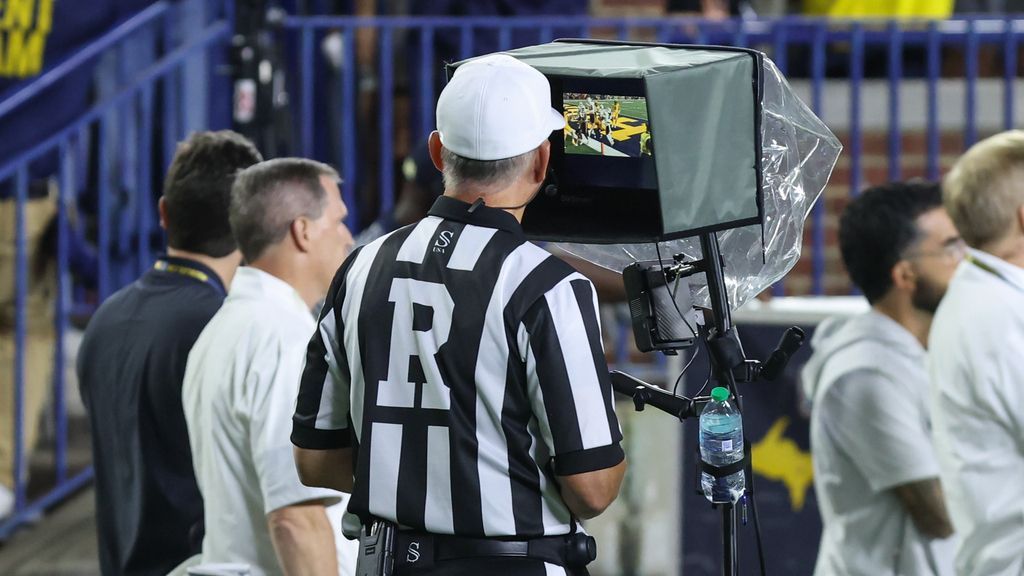
The NCAA says replay protocol broke down at the end of Western Michigan’s loss to Michigan, but the final whistle still cannot be uncoupled from the ledger.

Arch Manning apology: Texas QB addresses AI video backlash
Arch Manning moved quickly to apologize after joking about an AI video involving Steve Sarkisian and Holly Rowe. At Texas, the football never stops—but neither does the fallout.