
Dante Moore Injury Update: Oregon QB taken off on stretcher
A terrifying hit that turns a football afternoon into something far heavier.
 Beatrice Kensington6 min read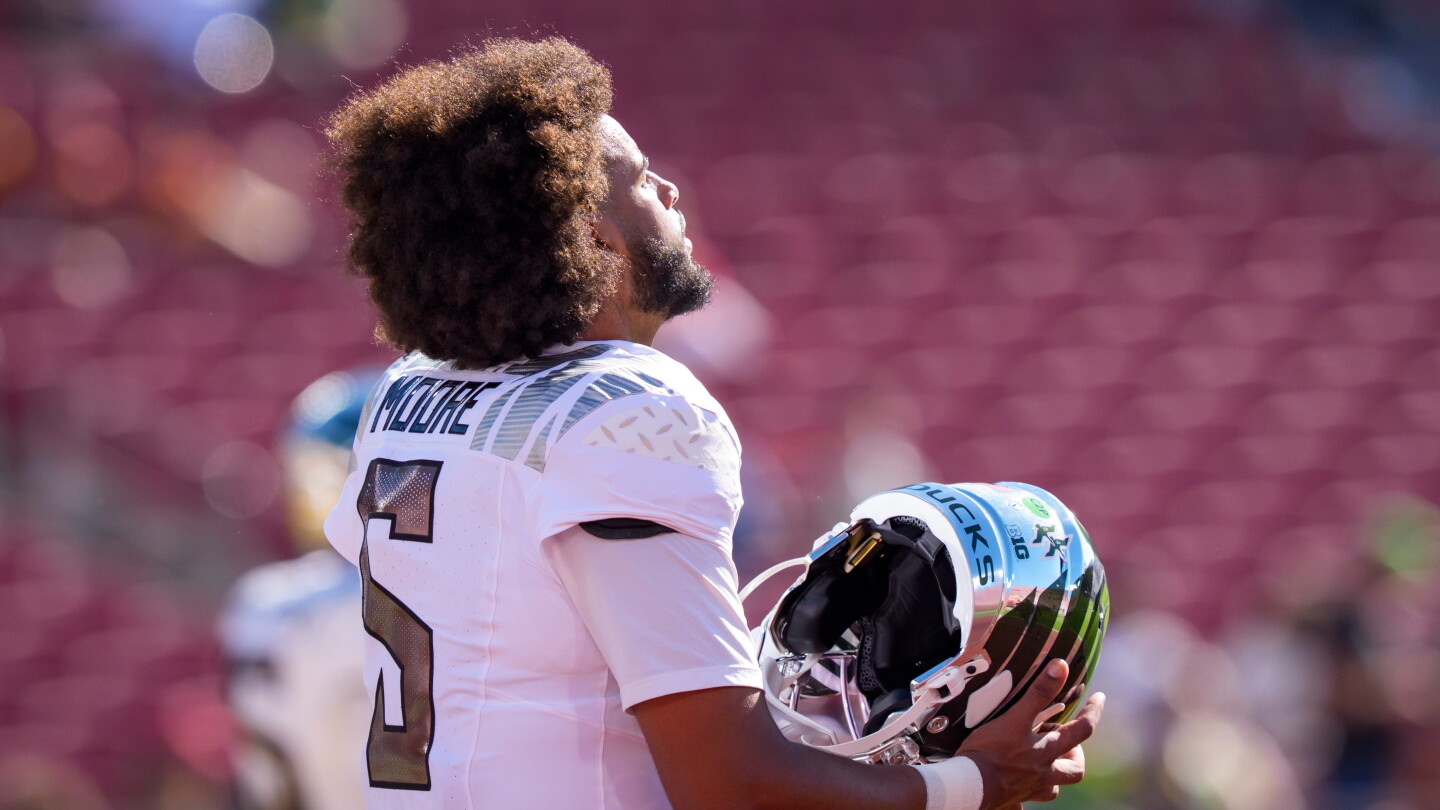
The scene was ugly in the oldest, most uncomplicated sense of the word: a quarterback sliding, a defender arriving with too much force, and then the terrible stillness that follows when a football field stops feeling like a stage and starts feeling like an emergency room with yard lines. Oregon’s Dante Moore, whose rise has already carried the kind of draft-day gravity normally reserved for polished veterans and Heisman-caliber stars, was struck in the head while sliding against USC and had to be placed on a stretcher before being carted to an ambulance. That is not a football moment. That is a human one.
The sport will do what it always does after a fright like this. It will replay angles, debate technique, invoke intent, and sort itself into camps. But the first obligation belongs elsewhere, and it belongs there plainly: to Moore, to his family, to the doctors, to the Oregon sideline that watched a promising season go from competitive to haunting in a matter of seconds. The rest is commentary, and much of that commentary will be too tidy for the violence of the thing itself.
A slide that ended in silence
Quarterbacks are taught to protect themselves by sliding, and defenders are taught — or at least expected — to pull up when the signal for surrender comes. That is the language of the rulebook, the civilized version of a game still built on collision. But the law of the field is not always the law of the moment. The speed at which a body can change from live action to helplessness is one of football’s cruelest truths, and it was on display here in the worst possible way.
Moore entered the day not as a curiosity but as a name with real weight. A quarterback with first-overall buzz does not just represent a college team’s present; he represents a franchise’s imagined future, the kind of future that starts drawing breath in mock drafts long before an athlete can reasonably be expected to have one eye on December and the other on April. That is the commerce of the modern sport. It can make a player feel larger than the roster around him while also making him more fragile in the public imagination.
The image of a player being stretchered off always does a kind of moral reset. The scoreboard recedes. The search for playoff seeding, conference standings, and recruiting momentum suddenly looks indecently small. Even a rivalry game, even one as charged as Oregon versus USC, can’t hold its own weight against that kind of sight.
What this means for Oregon, USC, and the season beyond the box score
For Oregon, the immediate impact is obvious, but the deeper consequence is less tidy. College football has become a machine that asks its best players to absorb professional levels of scrutiny while still living inside an amateur framework that offers them neither the protection nor the public patience of the NFL. When a quarterback with Moore’s profile is hurt, the injury is never merely about one Saturday. It reaches into a program’s national standing, its offensive identity, its recruiting pitch, and the fragile bargain between excellence and availability.
USC, for its part, will spend the next stretch under the shadow of how the hit was delivered and whether it crossed the line between aggressive defense and reckless contact. The game has long insisted that players are responsible for adapting to speed and space, yet the burden of caution never seems to sit evenly on those who initiate the violence. That tension has produced years of rule changes, education campaigns, and officiating emphasis, but football remains football. It is still played with bodies colliding at speeds that make perfect judgment a luxury.
The larger concern is one the sport often treats as background noise until it becomes impossible to ignore: the head injury crisis. We have spent enough seasons pretending that better helmets and cleaner language can neutralize the basic truth that brains do not belong in harm’s way as often as football requires them to be. A quarterback sliding should signal a protected moment. When it does not, the game reveals how thin its safety promises can be.
When a slide ends on a stretcher, the sport has lost the argument before the officials even reach the huddle.
The draft talk can wait; the person cannot
There is a particular cruelty in the way elite prospects get folded into future commerce before they have even lived through a full college career. Moore has been discussed in the language of January and April, of franchises and draft boards, of potential first overall status in 2027. That language is useful, even inevitable, because football is a talent economy and quarterbacks are its currency. But it can also flatten a young man into a projection, which makes a moment like this feel like a catastrophic interruption rather than what it really is: a reminder that no projection is sturdier than the body carrying it.
I have spent enough time around this sport to know the script that follows frightening injuries. There will be optimism first, then guarded updates, then a broader public relief if the news softens. There may also be a round of sanctimony from people who have never had to trust their body to the snap count. I resist that impulse. The better response is quieter and harder: recognize that the highlight economy often treats quarterbacks like investment vehicles, then remember they are teenagers and young men before they are assets.
And yes, I do think the sport is still behind where it ought to be on protecting sliding quarterbacks. Not because every collision can be legislated away — it cannot — but because football has built enough rules around defenseless players to know better than to leave these moments to instinct alone. The league level, the college level, every level that profits from the spectacle, ought to keep refining the standards that define what is and is not a late or dangerous hit. The price of being slow about that is paid in moments like this.
A game that should feel different now
The rest of Oregon’s season will go on, because seasons always do. Teams adapt, backups step forward, coaches lean on resilience like it is a family heirloom. Yet no one inside that locker room will forget how quickly one play can reorder everything. Nor should they.
If there is a lesson buried in this frightening afternoon, it is not about toughness. Football already has more toughness than it knows what to do with. The lesson is about restraint, and about the responsibility that comes with speed. A sliding quarterback is asking the game to stop. Too often, the game answers too late.
We will learn more about Moore’s condition in time. For now, the only honest response is the oldest one: hope, and the uneasy gratitude that the air has quieted around one of the sport’s brightest young names. The next snap can wait.
More from Straight From The Bench
Comments
Join the conversation — sign in to leave a comment.
Sign in to commentRelated Stories
Florida vs Ole Miss: Gators’ win sends SEC warning shot
Florida didn’t just beat No. 4 Ole Miss — it announced itself. The Gators showed they can bang with the league’s heavyweights and make it hurt.

Tennessee vs Texas: Vols fall short in SEC opener
Tennessee pushed No. 1 Texas to the edge, but the final margin still belonged to the Longhorns. For Josh Heupel’s team, the loss carries both warning and possibility.

Wisconsin vs Penn State live score: Big Ten opener tension
Wisconsin’s Big Ten opener against Penn State is already carrying postseason weight. The live score tells part of the story — the bigger issue is whether the Badgers can survive the line of scrimmage.