
Fever vs Aces: Jackie Young Security Incident and OT Thriller
A noisy night in Indianapolis became another reminder that women’s basketball is not a novelty act.
 Beatrice Kensington6 min read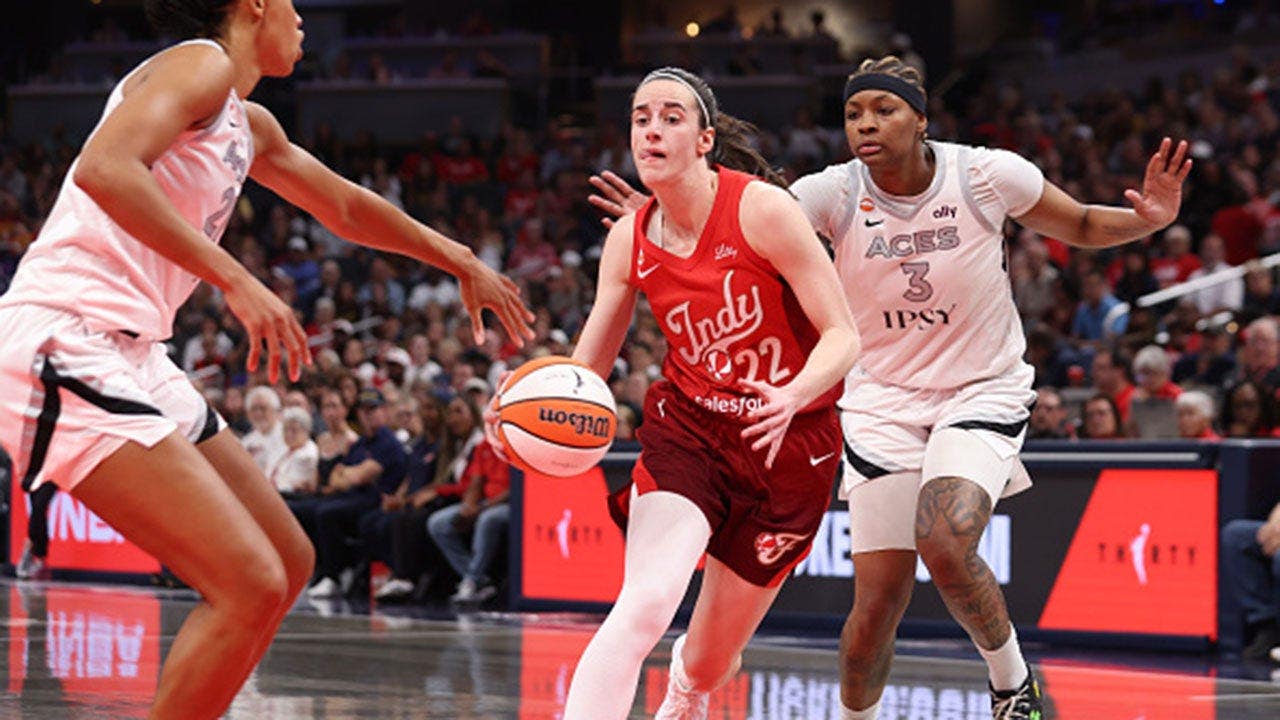
The loudest thing in Gainbridge Fieldhouse on Thursday night was not the final buzzer, though that one carried its own sharp little sting. It was the sound of a league arriving fully in its own skin — and refusing to be treated like background music for someone else’s entertainment. The Las Vegas Aces and Indiana Fever played an 86-84 overtime thriller that had all the brittle edge of a postseason game in midsummer, and for one stretch the basketball gave way to something uglier: Jackie Young) signaling for security to remove two courtside fans who had crossed a line that athletes, especially women athletes, know all too well.
It was a small tableau with a large shadow behind it. Young, one of the Aces’ steadier stars, did not appear interested in making theater out of it. She wanted the distraction gone. The game had enough pressure of its own. There was Caitlin Clark, every movement of hers carrying the weight of national fascination and local expectation; there was Chelsea Gray, who has built a career on turning tense moments into her own private weather system; and there was a building packed with people who understand, some more gracefully than others, that access is not the same thing as entitlement.
The fevered edge of a marquee game
This was always going to be more than a regular-season date on the calendar. Fever games have become a civic event, a television event, a culture-war proxy and, most of all, a basketball event that asks a great deal of the players who live inside it. Indiana’s home court has become one of the few arenas where the arrival of a visiting champion still feels like a provocation. Las Vegas did not come to admire the scene. It came to win.
That matters because the WNBA is now in the hard, necessary phase of growth where the product is too valuable to be treated casually and too visible to be protected by habit alone. Bigger crowds bring bigger noise, but also bigger responsibility. The best leagues learn quickly that the atmosphere around the game is part of the game. The worst ones wait until somebody gets embarrassed on the floor.
The Aces handled the night like a veteran outfit should. They absorbed momentum swings, weathered the fever pitch of a home crowd that has learned how to lean forward at the right moments, and then found a way in overtime. That kind of win does not simply add one more column to the standings. It reinforces a hierarchy. It tells every contender that Las Vegas does not need to be beautiful to be dangerous.
Jackie Young, courtside tension, and the line fans cannot cross
The security intervention is the story inside the story. Courtside seating creates a seductive illusion: proximity can feel like participation. It cannot. Players are not there to absorb personal commentary from paying customers who mistake access for invitation. The moment Young asked for help, she was defending not just herself but the basic etiquette of the sport.
The new era of women’s basketball will be measured not only by attendance and ratings, but by whether the people buying the most expensive seats learn how to behave.
That is not a sideshow. It is central to the league’s health. Women’s sports have spent decades navigating a stale bargain: earn legitimacy by entertaining, then tolerate whatever comes with the ticket sales. That bargain is over, or ought to be. The increase in attention around the Fever has been a gift and a burden, often in the same breath. Indiana sells out because people care. People care because Clark has forced the sport into a brighter national lens. Bright light, as ever, reveals the good and the grubby.
This is where the league’s growth story gets complicated. More attention does not automatically mean more understanding. More people in the building does not automatically mean better culture. The league can celebrate the buzz — and it should — while also making plain that players are not public property. Security is not a nuisance. It is part of the architecture now.
Chelsea Gray’s finish and the Aces’ old, brutal calm
There is a reason Chelsea Gray has long been trusted in the final moments of tight games. She plays with the sort of measured nerve that unsettles defenders and reassures teammates, the point guard equivalent of a hand resting flat on a table during an argument. In overtime, that matters. In a game where every possession felt like it had been carved out with a pocketknife, Gray delivered the shot that settled it.
The Aces have become expert at these moments because they do not panic when the air turns thin. Las Vegas Aces basketball, at its best, is a study in composure under bright lights. They can be pestered, pushed, and briefly disordered; they rarely become emotionally rearranged. That is why they remain dangerous even when they are not crisp. Championship teams understand that a messy night is not a lost night if the clock still belongs to them.
For Indiana, the loss stings differently. This is a team still writing its own identity around Clark, Kelsey Mitchell and a crowd that has begun to expect the improbable on schedule. The Fever are no longer simply the league’s fascination project. They are under pressure to become a durable winner. Narrow losses to elite teams can be instructive, but only if they harden into habits instead of headlines.
What this says about the WNBA’s next challenge
I have spent enough seasons watching women’s sports be forced to prove, again and again, that they are worthy of ordinary respect to know that nights like this carry a double meaning. On one side, you have the basketball itself — fast, skilled, unsparing, and better than the lazy stereotypes that once circled the league like moths. On the other, you have the social weather around it, still catching up to the fact that the athletes on the floor are not an exhibit. They are competitors.
And yes, the league has benefited enormously from the surge around Clark. Any serious observer can see that. But surges can distort as well as elevate. They pull in new money, new attention, new habits. Some of those habits are welcome. Some are not. The task for the WNBA, and for every arena that hosts it, is to keep the energy without surrendering the room. That is delicate work. It requires standards. It requires spine.
There is also a competitive truth worth keeping in view. The Aces and Fever may be building one of the league’s most compelling contemporary rivalries, and rivalries are the best kind of public good when they are rooted in actual basketball. Thursday night offered that, too: talent meeting talent, composure meeting noise, a veteran champion meeting a franchise trying to grow into its own shadow.
The Fever will get another chance to turn noise into fuel. The Aces will keep doing what the best teams do — arriving with a plan and leaving with the result. The league, meanwhile, will keep drawing more eyes. The real test is whether it can teach those eyes how to look.
That is the work now. Not the crowd. Not the spectacle. The standard.
More from Straight From The Bench
Comments
Join the conversation — sign in to leave a comment.
Sign in to commentRelated Stories
Megan Rapinoe and Sophie Cunningham accountability row
Megan Rapinoe’s call for accountability puts Sophie Cunningham’s comments back under the microscope. This is about sports, speech, and who gets dragged into the center ring.
Caitlin Clark and Paige Bueckers lead Team USA roster
USA Basketball finally leaned into the future, and it looks loud, skilled, and a little dangerous. Clark, Bueckers, Reese and Boston give the roster a new face.

Sophie Cunningham controversy: WNBA discourse keeps getting louder
Sophie Cunningham didn’t create the noise, but she sure knows how to live in it. The latest WNBA dust-up says more about the league’s spotlight than one player’s mouth.