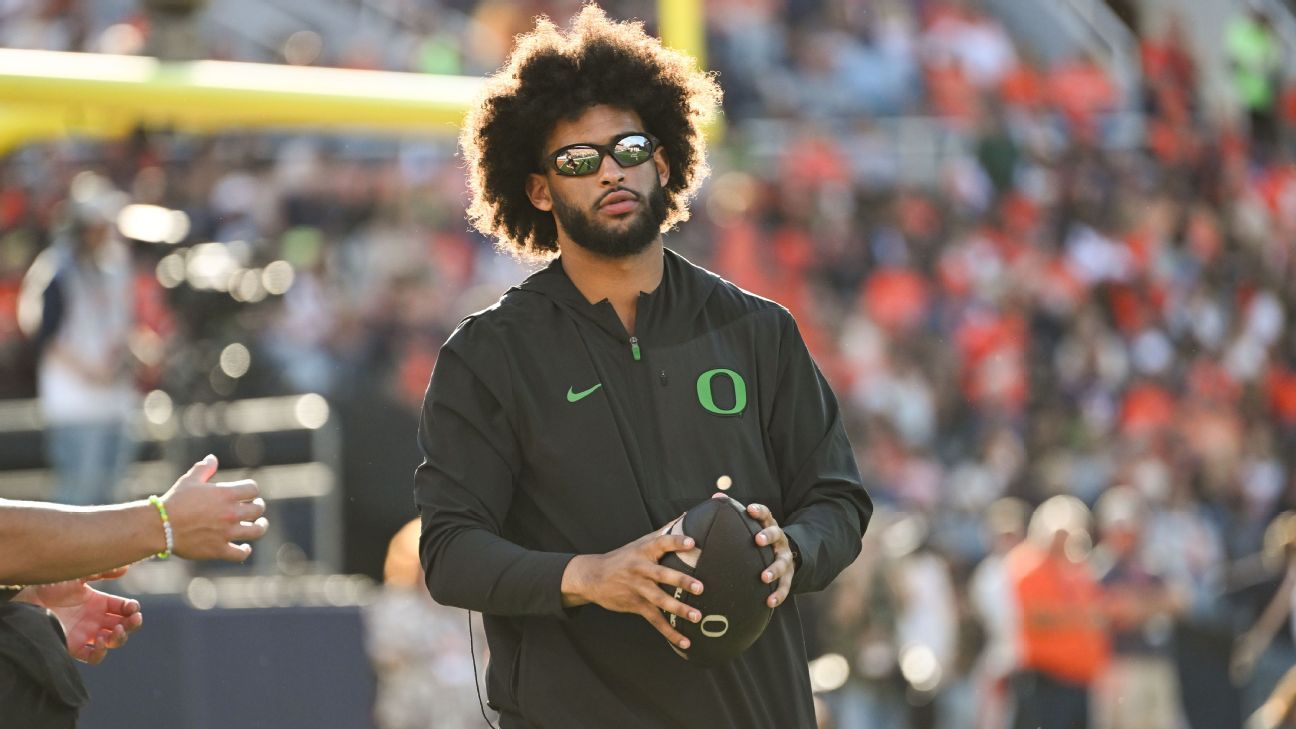
Oregon QB Dante Moore Injury Update: Season Likely Over
The Ducks are learning how quickly a title chase can lose its quarterback and its edge.
 Beatrice Kensington5 min read
Oregon’s season has lost the player who was meant to tilt it
The news around Dante Moore lands with the dull finality that only a season-ending quarterback absence can carry. Oregon coach Dan Lanning said Monday that Moore is not expected to return after missing the past three games with a concussion, and that sentence changes more than the Ducks’ depth chart. It changes the shape of their hopes, the tenor of their huddle, the way opponents will now draw them up on a whiteboard.
Quarterback injuries are never just medical events in college football. They are acts of subtraction. One Friday or Saturday, a team still believes in its own outline; the next, it is suddenly asked to win with a different silhouette. Oregon has lived long enough in the bright pressure of college football to know this truth, but knowing it and absorbing it are different chores entirely.
Moore was supposed to be one of the figures around which this season could turn. A young passer with a polished arm and the burden that comes with being projected, scrutinized, and measured before he has finished becoming himself. Instead, concussion protocol has handed Oregon a grim reminder that the most important position in the sport is also the one least willing to tolerate sentiment.
What Oregon loses when the offense loses its quarterback
The loss is not just statistical, though it is certainly that. It is rhythm, command, and the fragile trust that comes from a quarterback who sees the game a beat faster than everyone else around him. Oregon’s offense, built to stretch space and punish hesitation, can survive with replacements. It cannot pretend the result is the same.
This is the part of football fans talk around until the injury arrives. The quarterback is the interpreter of a system, the one who keeps the machinery from clanking and grinding in public. Without Moore, the Ducks must reassemble timing on the fly, and timing is the one luxury a team chasing a late-season goal rarely has.
A season can survive a missing starter. It rarely survives losing the person who was supposed to be its compass.
There is also the psychological cost, which coaches like to frame as next-man-up resilience and players feel as something closer to grief. Oregon’s locker room now has to process not merely an absence, but a stalled plan. That is different. It asks veterans to become steadier, linemen to become cleaner, receivers to become more forgiving, and the staff to become more inventive with less margin for error.
Dan Lanning’s challenge is bigger than the next snap
Dan Lanning has built his reputation on force of will, recruiting strength, and an unmistakable edge. Those qualities matter even more now. The public part of the job is to sound unshaken. The private part is to make sure the team does not confuse adversity with destiny.
This is where a program’s true architecture reveals itself. Some teams are built around a quarterback so singular that the whole operation rattles when he disappears. Others are built to absorb a blow, keep the structure intact, and squeeze value from the rest of the roster. Oregon has invested heavily in being the latter kind of place, and now it must prove it.
The timing hurts. Late-season injuries always do. They arrive when bodies are already taxed and scouting reports are already dense, when every opponent knows your tendencies and every possession feels like it comes with a tax audit attached. The Ducks do not get to pause and feel sorry for themselves. The calendar does not budge for sentiment.
The concussion conversation is bigger than one team’s race
There is a wider, sobering layer here that football always tries to keep in the background until it cannot. Concussions remain one of the sport’s most consequential and least romantic realities. The game continues to sell its speed, violence, and grandeur in glossy terms, but the body keeps the receipt.
I have written for years about how football’s mythology depends on pretending risk is something managed neatly by trainers in the tunnel. It is not. It is endured, negotiated, and sometimes paid in installments long after the stadium has emptied. A player like Moore, young and valuable and still being introduced to his own ceiling, deserves every bit of caution available. The sport has enough appetites already. It does not need another one.
That is why this development carries more gravity than a simple lineup note. Oregon can adjust its offense. It can tweak tempo, simplify reads, lean harder on its run game or ask more of the defense. What it cannot do is treat a concussion like a tactical inconvenience. The stakes are larger than the standings. They are human.
For Oregon, the immediate question is not merely who starts next. It is whether the rest of the roster can keep the season from shrinking into a series of emergency measures. Programs sometimes discover, in moments like this, that character is not some decorative word in a media guide. It is the ability to function without the thing you thought you could not live without.
What this means for the Ducks now
The Ducks still have talent. They still have a proud machine around the quarterback position and a staff that knows how to dress up a difficult week and send it into Saturday with purpose. But Moore’s absence changes the ceiling, at least for now, and perhaps changes the questions Oregon can honestly ask of itself.
I would watch two things closely. First, whether the offense becomes more conservative in order to protect the next quarterback and the line around him. Second, whether Oregon’s defense, often expected to carry itself with a certain elegance of its own, starts to feel the burden of being asked to do more than its share.
I keep thinking about how many college teams spend the autumn convincing themselves they are one healthy week away from full power. Then reality taps the shoulder. Sometimes gently. Sometimes not. Oregon has been tapped. Hard.
The Ducks still have games to play and an identity to defend, but the season has shifted in a way that cannot be wished back into place. Moore’s return is not part of the plan now. The rest of it is improvisation.
And in November, improvisation is where seasons go to reveal their true cost.
More from Straight From The Bench
Comments
Join the conversation — sign in to leave a comment.
Sign in to commentRelated Stories

Texas Tech football owners: Cody Campbell exposes the new model
Cody Campbell didn’t whisper what the sport has been becoming for years. Texas Tech’s power structure looks a lot more like pro sports now.

College GameDay Utah: Pat McAfee Says Utes Visit Felt Uncomfortable
Pat McAfee didn’t sugarcoat his feelings after College GameDay’s trip to Utah. One social media post from the Utes helped turn a showcase into a feud.

College GameDay Utah: Pat McAfee Slams Salt Lake Visit
Pat McAfee left Salt Lake City doing what he does best: making noise. The problem is, this time the noise landed on Utah, and not everyone’s laughing.