
Protect College Sports Act debate: CBC says Black Americans were sidelined
A bill about power, labor and money cannot be built on silence.
 Beatrice Kensington6 min read
The argument over the Protect College Sports Act has opened a familiar American wound: a policy conversation about Black labor, Black bodies and Black institutions, carried out in rooms where Black voices are too often treated as an accessory rather than a necessity. When Yvette Clarke, the Congressional Black Caucus chair, says the people most affected by the legislation have not been meaningfully included in shaping it, she is not making a procedural complaint. She is naming a pattern.
College sports has long sold itself as a pastoral enterprise, all school spirit and scholarship and amateur nobility, while the machinery underneath has always hummed with hard economics. The modern fight over athlete pay, name-image-likeness rules and conference power is not simply about whether a quarterback can sign an endorsement deal or whether a star guard can profit from a social media following. It is about who gets to write the rules in a system that has extracted enormous value from generations of Black athletes while offering them the language of gratitude in place of real authority.
A bill about reform that may repeat old exclusions
The very idea behind the Protect College Sports Act is, presumably, to bring order to the chaos that has overtaken the college game. NIL has shifted the ground under the entire enterprise. Schools, collectives, conferences and lawmakers are all trying to decide what counts as fair competition, what counts as pay-for-play and what counts as acceptable influence. But a reform bill can be morally thin even when it is dressed in the language of structure.
That is the unease here. If the people designing the fix do not include the people who bear the weight of the fix, then the law may protect institutions more than athletes. It may soothe presidents, commissioners and boosters while asking young men and women — many of them Black, many of them first-generation college students, many of them supporting families already — to absorb the consequences.
This is why the CBC’s criticism matters beyond Capitol Hill. It speaks to a history older than NIL and broader than sports: Black Americans have often been central to the labor, talent and cultural meaning of an American system while remaining peripheral to its governance. College athletics is one of the clearest surviving examples of that arrangement.
College sports still runs on old assumptions
The public conversation around college sports tends to focus on the loudest, richest programs: the SEC, the Big Ten Conference, the playoff chase, the legal battles, the transfer portal churn. But the moral center of the issue lies elsewhere, in the daily life of the athletes who keep the industry alive and rarely get to shape it.
A law that claims to stabilize the system must reckon with who has historically been asked to stabilize it without a voice. Black athletes have been the face of Saturday television, the backbone of revenue and, too often, the easiest people to discipline when the sport demands order. The same system that celebrates their excellence can become deeply nervous when they ask for a seat at the table.
That is what makes this debate so revealing. It is not only about compensation or antitrust or the governance tangle between universities and the NCAA. It is about whether America can build a new framework for college athletics without reproducing the old hierarchy inside it.
A reform bill that skips the people most affected is not reform. It is familiar power in new clothing.
Why the CBC critique lands with force now
The Black Caucus is not reaching for symbolism here. It is responding to lived stakes. For many Black families, college sports has been one of the few visible ladders into higher education, financial mobility and national prominence. Yet the ladder has always been narrow, and the rungs uneven.
When lawmakers talk about “protecting” college sports, I keep hearing a quiet but crucial question underneath the rhetoric: protecting whom, exactly? The universities that market athletes and sell the aura of educational virtue? The coaches whose contracts often look like a billionaire’s private fantasy? The athletes themselves, whose labor powers television deals, merchandise and stadium economies? Or the administrators who want to preserve control while acknowledging just enough change to keep the machinery from seizing up?
I have covered enough labor fights to know that the people with the most polished language are rarely the ones with the least power. In sports, that imbalance becomes almost theatrical. The uniforms are bright. The campuses are immaculate. The money moves in the shadows. Black athletes have been asked for decades to perform not only excellence but gratitude, as though access to the system were itself compensation for the system’s taking.
And so when Clarke says the affected communities have not been meaningfully included, she is putting a finger on the flaw that often ruins “reform” before the ink dries. The absence is not accidental. It is structural. A seat at the table is never given freely by a table built without you in mind.
What lawmakers should hear before they legislate
The better path would be obvious if the politics were not so tangled. Any serious college sports legislation should include current and former athletes, Black advocates, Title IX voices, labor experts and HBCU perspectives from the start, not as an afterthought to be quoted in a press release. If lawmakers want a durable system, they should build one that acknowledges the actual economy of the sport, not the myth of amateur innocence.
That means recognizing that the future of college athletics will not be rescued by slogans about tradition. It will be shaped by the distribution of power. Who sets standards for compensation? Who polices collectives? Who protects athletes from exploitation? Who makes sure that reforms do not deepen inequities between powerhouse programs and the schools trying to keep up? These are not side issues. They are the issue.
I would also argue this: the public is more ready for honesty than lawmakers sometimes assume. Fans know the old arrangement was false. They know the sport was never pure. They know the system has changed. What they do not want is a new set of rules that merely re-centers the institutions while leaving athletes, especially Black athletes, to carry the risk and inherit the lecture.
The next phase of this debate should be less about preserving the romance of college sports and more about respecting the people who have made the romance profitable. Anything less would be a polished rerun.
The bill’s fate will tell us whether Washington intends to listen this time, or simply rename the old hierarchy and call it progress.
More from Straight From The Bench
Comments
Join the conversation — sign in to leave a comment.
Sign in to commentRelated Stories

College Football Coaches Poll: Indiana, Notre Dame snubbed
Indiana has a legitimate gripe, Notre Dame was left staring at a shrug, and the SEC got the kind of cushion that always starts arguments.

College Football Overrated Teams: preseason poll’s loudest lies
The preseason Coaches Poll has done what it always does: reward habit, not proof. Some programs enter August with glow from last season still clinging to them like stadium dust.
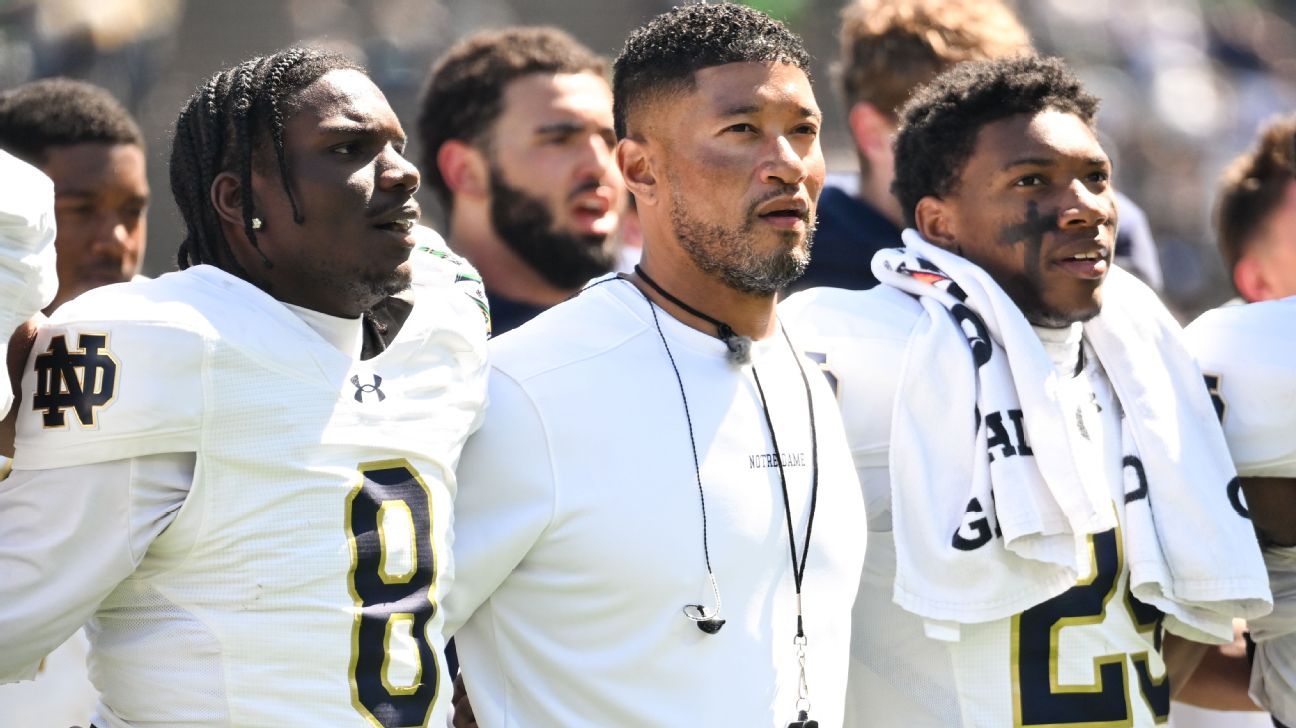
Notre Dame vs Wisconsin: Marcus Freeman Wants Playoff Out of Head
Marcus Freeman is trying to kill the preseason noise before it starts. Notre Dame’s real test is Wisconsin on Sept. 6, not some October bracket debate.