
Steelers vs Patriots: Aaron Rodgers calls out Pittsburgh’s offense
A blunt diagnosis from a quarterback who knows exactly how far the standard has slipped.
 Beatrice Kensington5 min read
Aaron Rodgers did not lace his words with perfume on Sunday. He looked at the Steelers’ offense after a listless loss to the Patriots and said what the tape had already been shouting: this is not winning football. In a league that rewards urgency and punishes self-deception, that kind of honesty can sound refreshing. It can also land like a door slammed in a quiet house.
Pittsburgh has spent enough years pretending that grit alone can keep the machinery humming. It cannot. Not anymore. Not in an NFL built for quarterbacks who turn field position into points and half-chances into momentum. Against a New England defense that was willing to hunt in packs, the Steelers looked slow to develop, thin on answers, and far too dependent on a veteran quarterback to be both the architect and the carpenter.
Rodgers says the quiet part out loud
The line that will hang over Pittsburgh this week is not complicated. Rodgers said the offense is not playing winning football, and there is no delicate way to translate that. It means the operation is fragmented. It means there are too many empty snaps, too many possessions that die in the middle of the field, too many moments when a drive feels like it has no spine.
That is the real issue here: not merely that the Steelers lost, but that they lost in a way that made the next phase of the season feel heavier than the first. A team can survive an ugly afternoon if the underlying rhythms are sound. It can survive dropped passes, a bad bounce, even a defensive lapse. What it cannot survive for long is an offense that keeps arriving one beat late.
The NFL official site has spent years selling the idea that parity is the league’s great equalizer, and in some ways it is. But parity is not the same thing as competence. The NFL will give you a chance; it will not save you from your own stagnation.
The Patriots made a veteran offense look old
There is a certain humiliation in being beaten by a defense that does not need fireworks to do its work. New England did not require a masterpiece from Drake Maye to control the day. The Patriots simply leaned into structure, pressure, and patience, and the Steelers never seemed to find the counterpunch.
That is what makes this loss sting beyond the standings. Pittsburgh was not merely outplayed. It was out-schemed at points, out-energized at others, and left looking like a team still waiting for its identity to arrive by mail. The line was leaky, the rhythm brittle, and the playbook felt narrower than the moment demanded.
A veteran quarterback can steady a flawed team. He cannot, by himself, make a broken offense look modern.
There is a hard truth lurking here for any franchise that leans on experience as if it were a substitute for acceleration. At some point, age is not wisdom. It is drag.
What this means for Pittsburgh’s season and locker room
The Steelers are at a crossroads that does not yet look dramatic on a schedule, but feels dramatic in the gut. There is still time to salvage a season, still time to shape a playoff narrative, still time for a passing game to become something more than a series of hopeful one-offs. But the margin for passivity is getting thinner by the week.
If you want the larger picture, look at the way defenses now attack teams built around veteran quarterbacks. They challenge the protection, squeeze the intermediate throws, and dare the offense to win with speed and sequencing. Pittsburgh has not consistently answered that challenge. That is not just a Rodgers problem. It is an organizational problem, a coaching problem, a construction problem.
I have watched enough seasons to know when a team’s language starts drifting away from its results. The Steelers still talk like a franchise that expects its name to carry weight, and in many rooms that expectation can be a useful thing. But on Sundays, the league is increasingly merciless to teams that mistake reputation for rhythm. What Rodgers said, stripped of its edge, is what many veterans eventually discover: the league does not grade on memory.
And if we are being candid, that may be the most telling part of this whole afternoon. Rodgers is not a rookie searching for his place. He is a quarterback long past the phase where optimism can be treated as a plan. When a player with that much experience says the offense is not good enough, the message is not just about execution. It is about urgency, accountability, and the uncomfortable suspicion that the current version of the Steelers may not have enough answers to satisfy its own standards.
The road ahead gets less forgiving
The next few weeks will tell us whether Sunday was an isolated flat patch or the beginning of a harsher truth. Pittsburgh needs cleaner protection, more consistent spacing, and a passing game that does not depend on improvisation to create dignity. The defense can still keep them alive. It may even carry them in stretches. But living on borrowed breath is not the same thing as building toward January.
For Rodgers, this is the part of the calendar where reputation either becomes a bridge or a burden. For Pittsburgh, it is the moment when the rhetoric of toughness has to make room for production. The schedule will not pause while the offense gets acquainted with itself.
The next game will not fix everything. It need not. But it must look like a team that understands the difference between trying and threatening somebody. That gap, right now, is wide.
More from Straight From The Bench
Comments
Join the conversation — sign in to leave a comment.
Sign in to commentRelated Stories

Jayden Daniels Injury Update: Commanders face a familiar ache
Jayden Daniels left with the same elbow in pain, and Washington’s season suddenly felt thinner. The score was already gone; the future is what now hurts.
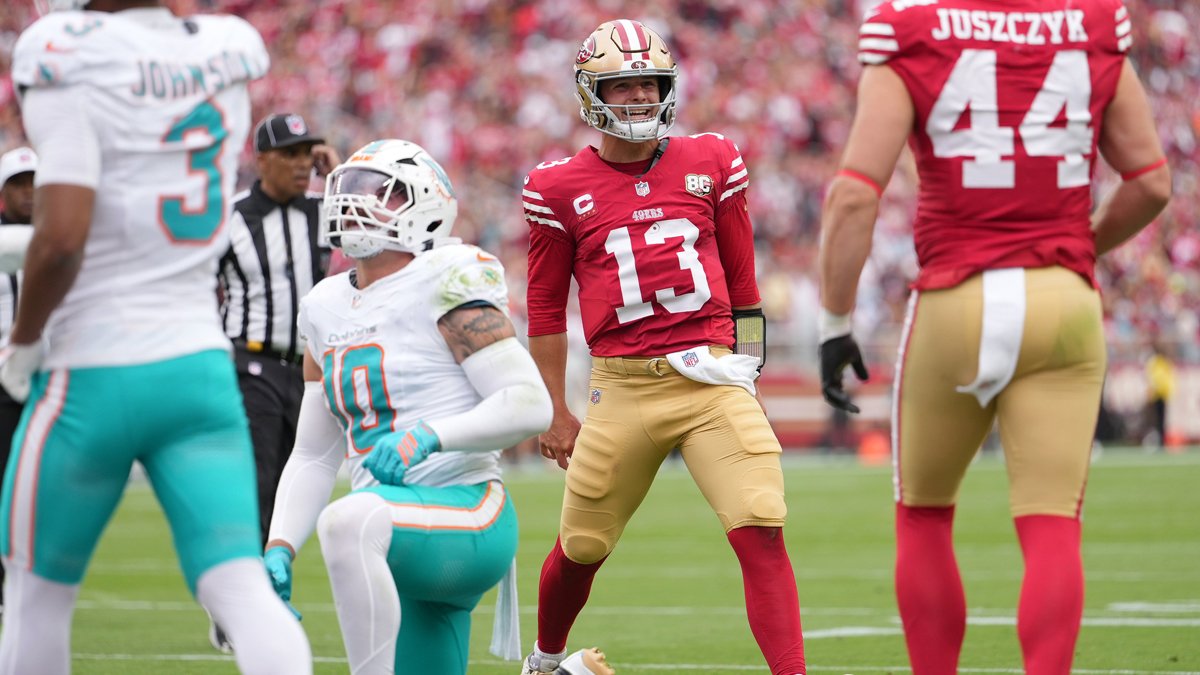
Brock Purdy Dolphins Game: 49ers QB shines in Week 2 win
Brock Purdy was razor sharp against Miami, and the 49ers didn’t just win — they controlled the game from the opening rhythm. That’s the kind of September performance that travels.

Eagles vs Titans: Jalen Hurts rallies Philadelphia late in 24-20 win
The Eagles got the kind of ugly road win that tells you plenty about a team. Jalen Hurts closed it out late, and Darius Cooper made the throw count.