
Athletics Injury Update: Mark Leiter Jr. and Joshua Kuroda-Grauer
The deadline clock is ticking, and Oakland’s margin for error just got thinner.
 Beatrice Kensington6 min read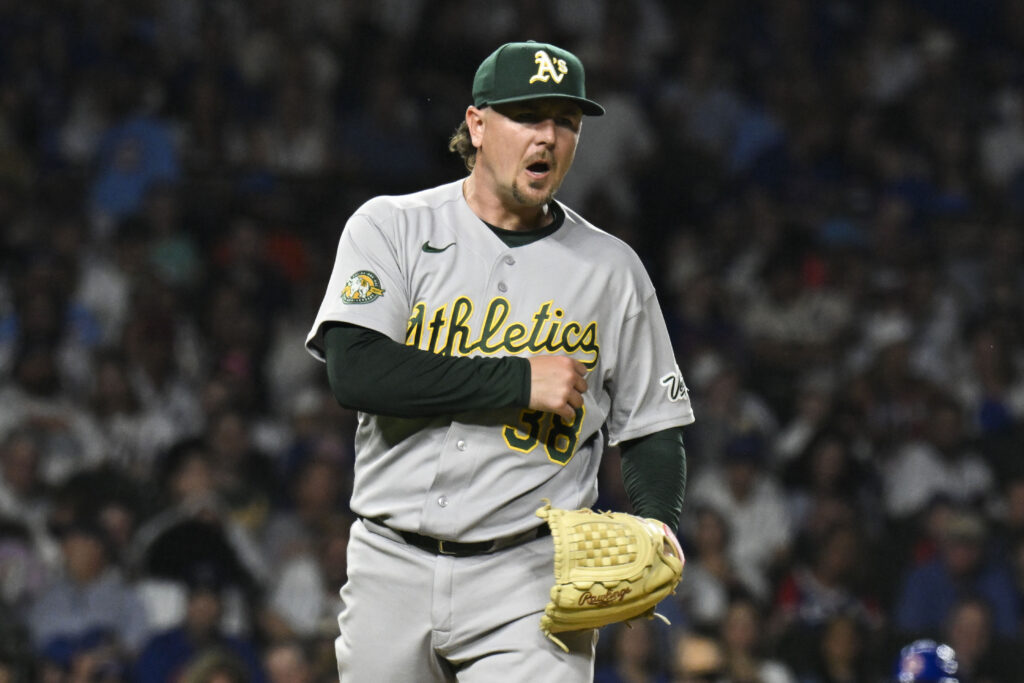
The Athletics lose more than innings and at-bats
The Athletics do not have the luxury of shrugging off small setbacks. Not in a season like this, not with the roster still being shaped as much by survival as by ambition, and certainly not when the calendar has begun its slow, punishing walk toward the trade deadline. The club announced that right-hander Mark Leiter Jr. has been placed on the 15-day injured list with a right hip impingement, retroactive to July 19, while infielder Joshua Kuroda-Grauer has also gone on the shelf. One is a veteran arm who could have been part of the July marketplace. The other is a younger piece of organizational depth. Both matter because the A’s are in no position to waste inventory.
This is the quiet arithmetic of a rebuilding club. Every injury is not just a medical update; it is a subtraction from a shallow ledger. For a contender, an IL move might be a temporary inconvenience. For the Athletics, it can alter the shape of a week, a bullpen, even a deadline plan. They are not merely trying to win games. They are trying to keep enough functioning parts on the field to evaluate, to sell, and to survive.
Mark Leiter Jr. and the deadline squeeze
Leiter’s name carries a different kind of weight than most injury notes do this time of year. A right-hander with major league experience, he is the sort of reliever clubs often circle when they are looking for a useful arm that can be folded into a contender’s October calculus. That is why the hip issue matters beyond the usual IL paperwork. When a club is fielding calls, health becomes leverage. A pitcher with a live arm and a clean medical chart is worth more than one whose status is foggy.
That is the harsh, transactional truth of deadline season. A player is not only a player; he is a possible return. The A’s will know that as well as anybody. They have lived for years in the seam between rebuilding and reconfiguration, where the front office must balance long-term patience against the very real need to extract value when it appears. A shortened timeline for Leiter, or a lingering hip problem, could take a modest but useful trade chip and turn it into a question mark.
Injuries do not just weaken a roster in July; they quietly tax its leverage.
There is a reason front offices keep so close an eye on the injured list in late July. It is where opportunity slips, often without ceremony. One reliever’s hip can force another bullpen inning onto a taxed shoulder elsewhere. One unavailable veteran can make a seller’s market a little less favorable. The A’s may not be staring at a dramatic collapse here, but they are certainly watching the walls narrow.
Joshua Kuroda-Grauer and the cost of losing depth
Kuroda-Grauer’s absence lands differently, but it still leaves a mark. Depth players are the invisible scaffolding of a baseball season, and teams notice their absence only when the scaffolding vanishes. That is especially true for a club such as this one, where the roster has to absorb turbulence without much decorative cushion. The Athletics have spent enough time assembling the pieces that even the back-end options are not disposable.
If Leiter’s injury affects the deadline conversation, Kuroda-Grauer’s absence affects the day-to-day grind. It means another reshuffle, another call to cover innings or an infield spot, another small strain on a club that does not have a surplus of answers waiting in the wings. In a season where the margins already feel hand-cut, those little absences pile up into something larger and more stubborn than the injury report suggests.
That is why the move resonates beyond the two names on the transaction wire. It touches the pitching staff’s workload, the bench’s flexibility, and the organization’s ability to keep fielding a competent club while the business side of the sport starts to hum louder. The A’s are in the awkward middle ground where every performance still matters, yet every healthy body also has a market value. That is a difficult place to stand. Baseball, at its most human, asks players to perform while their names are being weighed in an entirely separate conversation.
What this signals for Oakland’s next move
This is where the season turns practical. The A’s will need to decide whether Leiter’s injury is a temporary pause or the sort of setback that complicates his availability well past the deadline. They will also have to cover Kuroda-Grauer’s absence without letting the roster become brittle in spots already vulnerable to attrition. Those are not glamorous decisions. They are the maintenance tasks of a club trying to keep the machine running long enough to make the next judgment call.
I’ve long believed July tells the truth about an organization in a way April never can. April is optimism in cleats. July is accounting. You see which clubs have too much pride to admit they need help, which ones have enough depth to shrug off an injury, and which ones are forced to negotiate with reality every morning. The A’s, by virtue of where they are in their cycle, live closest to that last category. They cannot paper over absences with reputation. They have to solve them with bodies, options, and patience.
There is also a subtler cultural point here, one that baseball people understand even when they dislike hearing it: the injured list is often where a rebuilding club’s plan meets the limits of its infrastructure. The teams with stable systems absorb these hits more gracefully. The teams still constructing theirs feel every crack. Oakland is still building. That makes even a routine-looking IL note feel heavier than it should.
The deadline window just got a little harder to work
The A’s may yet turn these absences into something manageable. Baseball allows for that kind of repair if the replacements hold and the injury stays contained. But the margin for error is slimmer now, and the front office has one more variable to fold into its decisions. If Leiter returns quickly, he can still be part of the deadline market. If not, the A’s may have to settle for a smaller return or hold him altogether. That is how quickly July can change the temperature.
For now, the story is not drama. It is pressure. The sort that builds slowly, then all at once. Oakland has another test on its hands, and the roster, already thin in places, must answer again.
The deadline is coming. The injured list just made the road a little rougher.
More from Straight From The Bench
Comments
Join the conversation — sign in to leave a comment.
Sign in to commentRelated Stories

Mariners Injury Update: Julio Rodríguez and J.P. Crawford out
Julio Rodríguez and J.P. Crawford sat out Tuesday with day-to-day issues, and Seattle’s lineup card came out later than usual. For a contender, even “minor” absences can ripple.
MLB Draft Changes: MLBPA Pushes Back on Owners' Proposal
The MLBPA is drawing a hard line against a proposal that would shrink the draft and squeeze amateur bonuses. The fight is about access, leverage, and who gets to shape baseball’s future.
Braves Release Kyle Farmer: Atlanta’s Roster Squeeze Tightens
Atlanta cleared room for Mike Yastrzemski by releasing Kyle Farmer, a reminder that every roster spot in October country is fought over in July.