
Caitlin Clark Record Game: 45 Points, 10 Assists vs Storm
A night of release, rage and precision from a player the league still hasn’t found a language for.
 Beatrice Kensington6 min read
The roar inside Gainbridge Fieldhouse said what the numbers could not
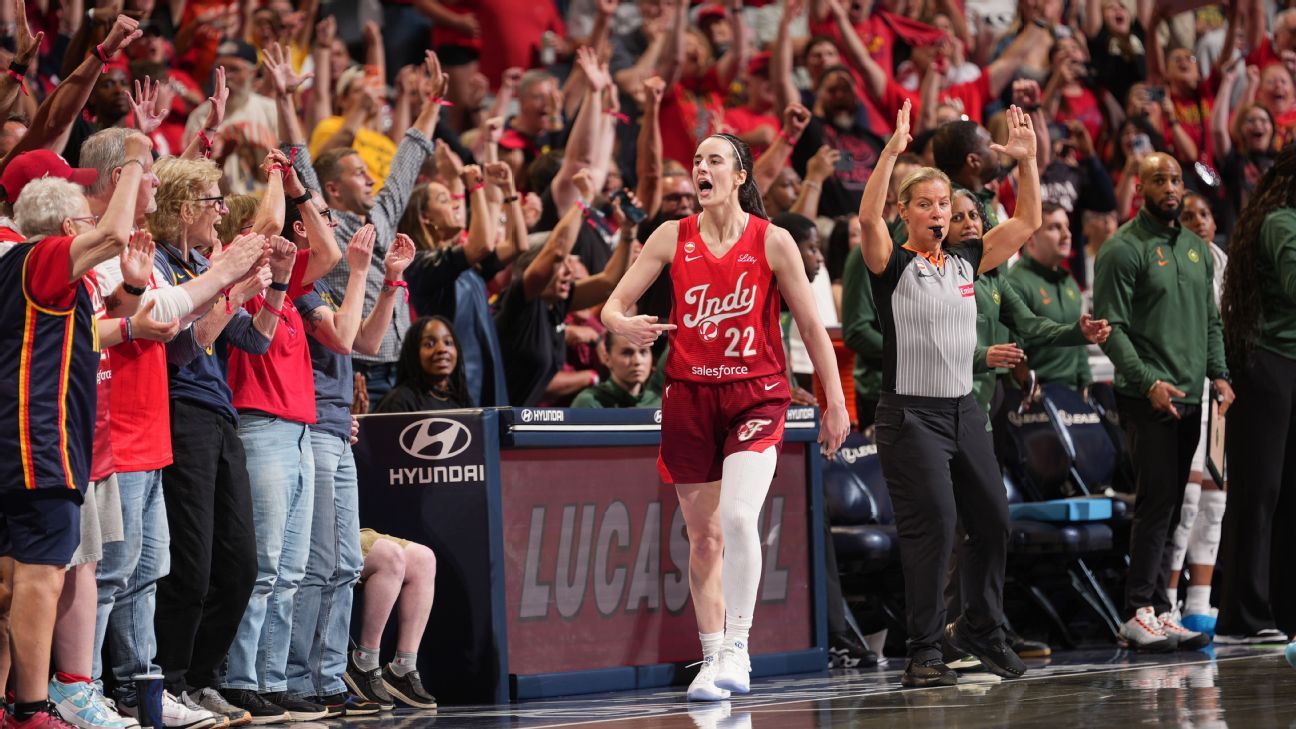
Caitlin Clark did not merely play well against the Seattle Storm. She cleared a room. She bent the game to her will, then stood there afterward in the gold-trimmed blue of the Indiana Fever and let the moment wash over her, tongue out, chest heaving, the building shaking around her like a warehouse caught in a summer storm. Forty-five points. Ten assists. Twenty-nine minutes. Records scattered. And for once, the number feels too tidy for the feeling it left behind.
This was the sort of performance that changes the air around a team. Not because one player can do everything, although Clark often looks as if she might try, but because the evening carried the force of release. There was frustration in it, too, and a little defiance. You could see it in the way she kept attacking, kept pulling Seattle’s defense into uncomfortable places, kept playing as if any pause might invite doubt back in.
The Seattle Storm were not a footnote. They were the opposition, and they were the witnesses. Yet this became Clark’s night in the oldest sense: a performance so vivid it made everyone else feel arranged around it.
Why 45 and 10 matters more than a headline number
The raw totals are gaudy, yes, but the more revealing figure is the time. Twenty-nine minutes is a short workday for a player who produced a line that would embarrass many full-game efforts. That efficiency matters because it speaks to control, not chaos. Clark was not merely shooting herself into a frenzy. She was reading the floor, puncturing coverage, and using Seattle’s attention to create seams for Indiana’s offense.
That is the part people sometimes miss when they chase the spectacle. Clark’s scoring gravity is the obvious theater, but her passing is the machinery beneath it. Ten assists mean the defense was forced to make a second and third choice every possession, and once that happens, the entire structure starts to wobble. Opponents have spent a year trying to decide whether to crowd her jumper, cut off the lane, or live with the cross-court punishment. Against Seattle, the answer looked worse than any of the options. She found the cracks and kept widening them.
This was not a hot shooting night in search of meaning. It was meaning, dressed as a box score.
For a league still learning how to live with an attraction this large, that distinction matters. A loud scoring night can be dismissed as variance. A night in which the scoring and playmaking arrive together, in rhythm, against a veteran opponent, is something sturdier. It hints at a player settling into command rather than merely talent.
Stephanie White’s reaction tells you how the Fever see her
Stephanie White’s disbelief after the game — the kind that leaks out before a coach can sand it down — was its own form of testimony. Coaches are supposed to be the adults in the room, the steady hands, the people who talk about process while everyone else chases fireworks. White did not hide from the spectacle. She acknowledged it with the plain astonishment of someone who understands she is standing in front of a force the league will spend years adjusting to.
That matters because the WNBA is no longer asking whether Clark is relevant. It is asking how to build around the gravity she creates. Indiana’s future, and perhaps a chunk of the league’s business future, is now tied to the quality of the answers around her: spacing, tempo, toughness, poise. The Fever need more than appreciation. They need structure worthy of a player whose gifts arrive in clusters and who can change not just a scoreline but the emotional weather in the building.
The burden here is subtle and heavy. Clark is asked to be transcendent, then asked to be patient, then asked to absorb every defensive wrinkle designed to make transcendence look ordinary. There is nothing ordinary about what she did to Seattle. And the larger the star gets, the more the league’s ecosystems shift around her: arenas fuller, opponents more prepared, broadcasts more breathless, expectations more unforgiving.
For more on the broader American appetite around the women’s game, see our take on soccer fans in America finding the real U.S. and how audiences respond when a sport’s personality finally matches its scale.
The human cost of being the center of everything
I have watched enough star athletes to know that the public usually describes greatness as if it were a kind of weather — natural, inevitable, impersonal. It is anything but. Greatness is labor, repetition, bruising, and a peculiar loneliness. The player at the center becomes a symbol so quickly that she is often denied the simpler dignity of being a person having a night. Clark’s performance against Seattle was not abstract. It was sweaty, physical, edged with emotion. It felt lived in.
That is why the scene lingered. Not just the points. Not just the assists. The pointed finger at the jersey. The roar. The body language of a player who seemed to say: this is mine, too. In the history of women’s basketball, that kind of ownership has often had to fight for room against condescension, against the habit of framing female excellence as either novelty or exception. Clark is operating in a different era, but not one free of those old instincts.
I think that is what makes her most compelling right now. She is not only expanding the statistical ceiling; she is shrinking the distance between what the league has been told to be and what it can become. There is a line from the pioneers of the sport to this moment, and it runs through gyms that were too small, television windows that were too narrow, and audiences that were told to look away. Clark does not carry that history alone, but she is visibly reshaping its next chapter.
For another angle on the generational pressure that comes with being both prodigy and public property, revisit our Caitlin Clark record night and the burden that comes with every new benchmark.
What this means for Indiana — and for everyone else
The Fever needed a night like this because seasons are not built only on standings. They are built on belief, and belief is often manufactured in one incandescent evening. A 45-point, 10-assist game gives Indiana a blueprint, yes, but it also gives the franchise oxygen. Teammates get a different kind of defensive attention. Opponents start game-planning with more caution. Fans arrive expecting possibility, not merely competence.
For the rest of the league, the warning is plain. If Clark is scoring at this level while still functioning as a primary creator, then every scouting report becomes a negotiation with failure. You may contain one avenue. You may not contain the entire storm.
That is the cruel elegance of elite guards: they force everyone else to decide how much pain they are willing to absorb. Seattle learned that lesson the hard way. Indiana benefited. The league, as ever, will have to answer whether it wants to treat nights like this as anomaly or architecture.
The next game will not be this game. It never is. But the trace of it will remain, and everyone in the building will feel it the moment Clark touches the ball.
More from Straight From The Bench
Comments
Join the conversation — sign in to leave a comment.
Sign in to commentRelated Stories

LeBron James Next Team: Championship Habits Guide His Choice
LeBron James is narrowing his next destination with a familiar demand: proof of winning habits, not just bright jerseys. The chase is now about structure.

Angel Reese Suspension: Sandy Brondello’s WNBA Remark Stirs Heat
Sandy Brondello’s protected-species comment about Angel Reese lit up the WNBA’s group chat economy. The punishment was quick, the debate even quicker.
Caitlin Clark WNBA record: 45 points, 10 assists, 40-10 game
Caitlin Clark authored the first 40-point, 10-assist game in WNBA history as the Fever edged Seattle 110-107. The record book moved, but so did the league's center of attention.