
Eagles vs Titans heat: Cam Jurgens on Nashville’s blazing turf
When the field itself turns hostile, football becomes a test of survival.
 Beatrice Kensington6 min read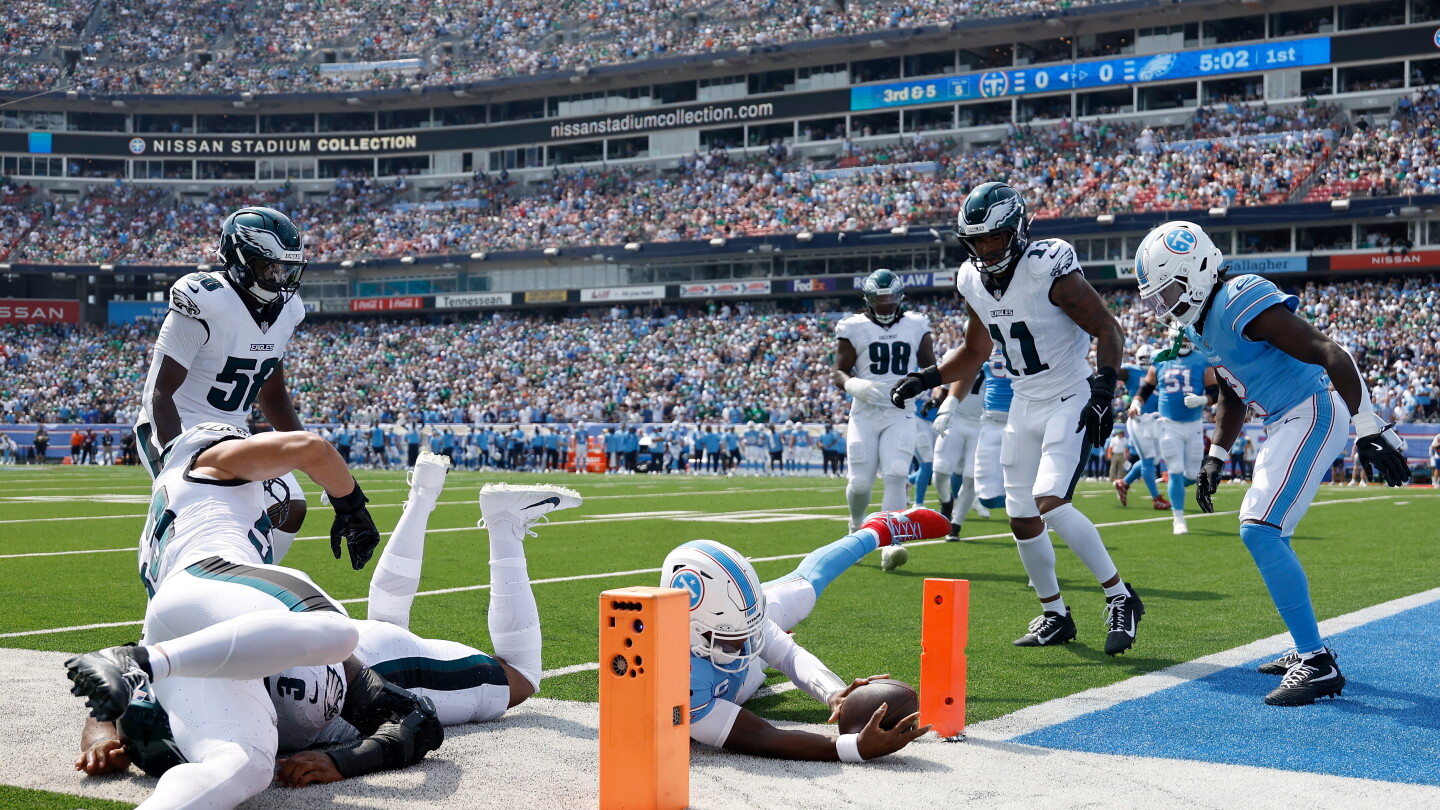
Nashville did not offer a football afternoon so much as a furnace with yard lines
Cam Jurgens did not speak like a man looking for sympathy, and that is part of what made the remark land. The Eagles and Titans walked into Sunday’s game in Nashville and found a field that, by every account, had turned punishingly hot beneath their cleats. Not the clean heat of a summer day. The kind that climbs up through the turf and sits in the ankles, the calves, the lower back — the sort of atmosphere that reminds players, in a hurry, that football is still an outdoor labor, not a showroom product.
That matters. Not because the game was uniquely heroic for enduring weather, but because the conditions were the story whether the broadcast wanted them or not. When a center like Jurgens notices the ground itself radiating heat, you are no longer talking about discomfort in the abstract. You are talking about balance, footwork, hydration, and the thin line between a normal Sunday and a night of cramped hands and dulled legs.
Heat changes the shape of the game long before the scoreboard does
The public tends to talk about heat as if it is merely a backdrop — something fans wipe from their foreheads and players swallow with electrolyte packets. On the field, it is more invasive than that. It slows the pass rush by fractions and taxes every lineman who has to anchor his stance against a surface that feels alive under him. It makes the trenches feel even narrower, the margins even smaller. And in a sport already built on leverage, those margins are the whole thing.
The NFL has spent years trying to sell the idea that football can be played anywhere, in any month, under any sky. That is a commercial instinct. The body has its own opinion.
There is a reason teams build summer operations around shade, cold tubs, cooled benches, and the careful choreography of sideline recovery. Extreme heat does not just reduce comfort; it alters decision-making. A tired player reaches a step late. A dehydrated player loses clarity on a route adjustment. A lineman whose legs are filling with heat cannot reset his base as quickly after contact. These are not dramatic problems in the way fans love drama. They are small, cumulative erosions. And small erosions decide games every week.
The field was not neutral. It was an opponent.
What the Eagles and Titans were really playing against
Philadelphia has built much of its identity on stamina and strain, on the idea that it can impose its will over four quarters and then some. Tennessee, meanwhile, has always had to wring value from grit, from weather and terrain and a certain stubbornness that suits its football culture. Sunday’s conditions stripped away the romantic version of both and revealed the same truth: nobody gets to bully physics.
That is why comments like Jurgens’ resonate beyond the box score. They speak to the hidden tax on interior players, the people who spend three hours with shoulders colliding, hands fighting for purchase, lungs working in soup-thick air. Skill players get headlines. Centers, guards, and tackles absorb the climate. If the playing surface itself is hot enough to register in the player’s memory afterward, then the game has crossed from “difficult” into “structurally compromising.”
This is also where the league’s careful language around player safety starts to feel a little thin. Concussion protocols get the airtime; heat stress often arrives in quieter ways. But the body does not care whether the threat is flashy. Heat can sap performance, raise the risk of cramps, and turn routine exertion into something bordering on industrial. You can ask any veteran of a late-August camp in Nashville — or in any Southern stadium that bakes through the afternoon — and he will tell you that the grass, the paint, the metal, the pads, all of it conspires against you.
The human cost hidden inside “just weather”
I have always believed football’s most enduring lie is that conditions are conditions, as though a hot field or a slick one or a windy one is merely part of the scenery. It is not scenery. It is workload. It is strain. It is the invisible opponent that does not show up in the stat sheet, though it can leave fingerprints all over one.
I remember the old league wisdom that real football separates the prepared from the merely talented. There is truth in that, but there is also a cost the phrase tends to smuggle in. Preparation in extreme weather is not a quaint virtue; it is a survival mechanism. The league loves the language of toughness because toughness sells. What it does not advertise nearly enough is the way hot surfaces punish the very fundamentals that make the game watchable: clean breaks, sharp cuts, crisp line play, precise timing.
And there is a broader issue here, one that feels bigger every season as the calendar seems to stretch into harsher edges. Stadiums are no longer just buildings; they are climate engines, too. The surfaces beneath players matter. The materials matter. The scheduling matters. If a field in late summer can become a griddle, then the conversation cannot stop at “the players dealt with it.” That is the cheapest answer available, and the league has used it for too long.
A warning wrapped inside a throwaway line
Jurgens’ comment will probably live in the footnotes for most fans, which is a shame. These are the kinds of observations that tell you what the television angle misses. Not the fireworks. The friction. The fact that a game can remain competitive while quietly asking too much of the people inside it.
The 49ers’ injury burden has already shown how quickly a season can be bent by physical wear. Heat is part of that same family of stressors: less visible, but no less ruthless. It changes the week after the game, too, because recovery starts from a worse place.
If you want to know whether Sundays like this matter, look not at the speeches but at Monday’s bodies. Look at the linemen whose steps feel heavy. Look at the conditioning staff. Look at the players who say they are fine and then move like men carrying wet sand in their shoes. That is where extreme conditions reveal themselves — not in the rhetoric, but in the residue.
The next time the league shrugs and calls it a hot day, remember this one. The turf was radiating heat in Nashville. So were the consequences. And they do not cool quickly.
More from Straight From The Bench
Comments
Join the conversation — sign in to leave a comment.
Sign in to commentRelated Stories

Colts vs Chiefs Overtime Ruling: Clear-and-Obvious Missed
The overtime review in Colts-Chiefs had one job: fix the obvious. Instead, it left the wrong team standing and the whole standard looking flimsy.

NFL Week 2 Injury Update: Daniels, Williams, Watson on the Move
Jayden Daniels and Caleb Williams left Week 2 with fresh uncertainty, while Deshaun Watson tried to steady the Browns’ quarterback conversation.
Chargers vs Raiders: Derwin James says the truth after 0-2 start
Derwin James stopped dressing it up after another Chargers collapse. Two games in, the same old problems are staring back at them.