
Humanoid Robot Games: Runners Break Records, Then Burn Out
The spectacle is real. The utility is still learning how to stand up.
 Beatrice Kensington6 min read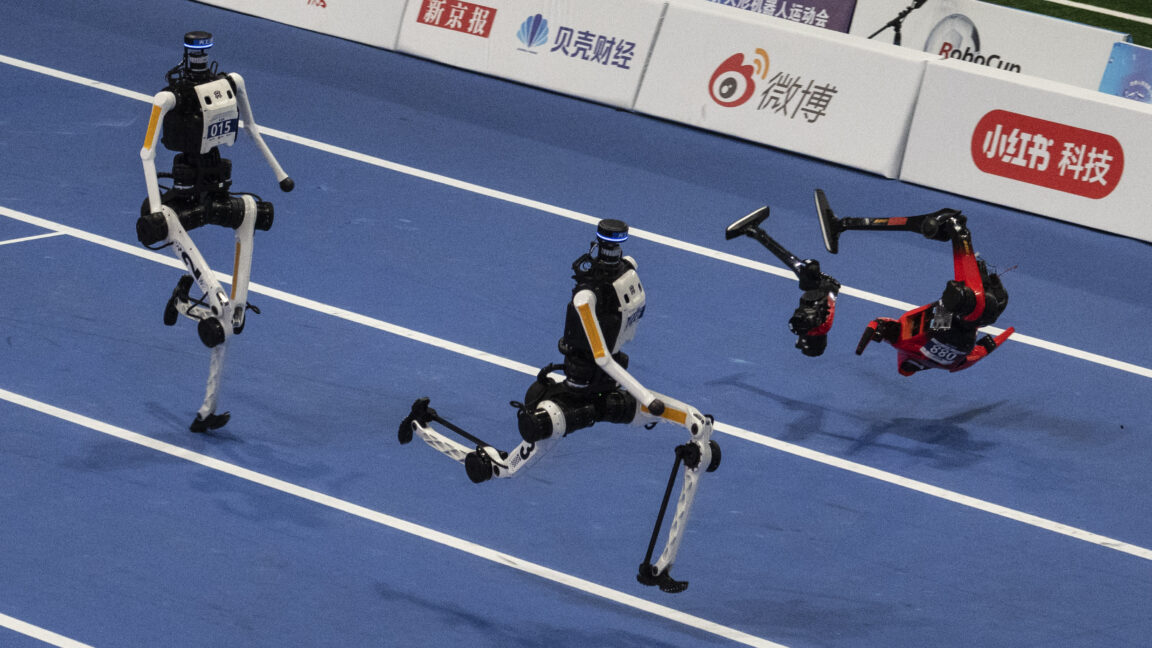
The first thing to understand about the Humanoid robot Games is that they are not really about the medals, or the finish times, or even the occasional plume of smoke that makes the crowd gasp and laugh in the same breath. They are about aspiration, staged under bright lights. A machine lurching down a track on two legs is an image that still carries the old electric charge of science fiction, the promise that tomorrow might arrive with joints and lithium batteries. Yet the races also exposed the stubborn truth beneath the spectacle: speed is easier to celebrate than usefulness, and running is still a party trick compared with the daily humiliations of the household floor, the cluttered kitchen, the stairs, the dropped laundry basket.
The spectacle matters anyway. Humans have always loved watching a new form learn how to move, whether it was the first airplane wobbling over a field or a raw prospect with fast-twitch legs and no idea where the strike zone is. These robots, in their best moments, looked less like finished products than like adolescents in oversized shoes: awkward, eager, promising, and not yet reliable. That is the real headline. The race was not a declaration that the age of the domestic android has arrived. It was a reminder of how long the road remains.
Records on the track, not in the home
There is a world of difference between a robot that can be coaxed into a straight-line sprint and one that can navigate the chaos of human life. The tip’s plainest truth is also its sharpest: record-breaking robot races are less substantial than household chore challenges. Running is a controlled environment. A hallway is not. A track does not ask a machine to sort socks from towels, to recognize a fragile glass on a crowded counter, or to recover gracefully when a child, a dog, or a chair is in the way.
That distinction matters because it separates theater from labor. The robotics industry has long relied on a familiar public-relations rhythm: demonstrate a flashy capability, then invite the audience to project the rest. But the rest is where the money, and the hard engineering, live. Machines that can reliably do chores would alter elder care, logistics, manufacturing, and eventually the shape of the middle-class home itself. Machines that can run fast mostly sell wonder.
The burning, too, tells its own story. Batteries overheat. Motors strain. Balance fails. These are not minor footnotes; they are the actual terms of the bargain. For every clean finish, there is a little disaster waiting off-camera. Engineering is not magic, and the body of a robot is an argument with gravity that never ends.
A robot that can sprint is interesting. A robot that can clean a kitchen without setting itself on fire is civilization.
Why the crowd keeps showing up
The humanoid robot form is a deliberate act of mimicry. It is not the most efficient shape for most tasks. Wheels are better for many surfaces. Robotic arms are better in factories. Yet the human outline keeps winning the pitch because we have built our world for bodies like ours — doors, handles, stairs, counters, tools. If robots are going to live among us, they must learn our geometry or we must rebuild the world around their conveniences. That is a quieter, more expensive argument than a race, and far more consequential.
The crowd's appetite for these contests also speaks to a cultural hunger for proof that the age of artificial intelligence is not merely verbal, not merely text in a box and a chatbot on a phone. People want embodiment. They want to see computation occupy space, bump into the rails, recover, fail, and try again. That desire is understandable. It is also revealing. We trust a thing more readily when it sweats, or sputters, or at least looks as though it might. The human animal has always been susceptible to a machine with elbows.
A real breakthrough will not look glamorous at first. It will look boring. The future of household robotics will be built on balance, battery life, safe gripping, sensor fusion, and the ability to do the same task ten thousand times without drama. No one will clip that onto a highlight reel. Yet that is where the value resides. Not in the 100-meter dash. In the loaded dishwasher.
Beatrice Kensington: the danger of mistaking novelty for progress
I have watched enough of these technology spectacles to know how easily we confuse a demonstration for a destiny. The first flying machines did not become airlines simply because they lifted off the ground. The first self-driving prototypes did not erase the need for roads, rules, and human judgment simply because they rolled forward in a parking lot. The same caution applies here. We are seeing the outline of a new labor class, not its arrival.
What unsettles me is not the robot that falls. It is the ease with which we cheer the fall as entertainment and then skip past the harder question: who gets replaced when the machine no longer falls? If humanoid robots eventually become competent at domestic work, that promise will not distribute itself evenly. It will arrive first where labor is scarce or expensive, then where profits demand it, and only afterward — if at all — where ordinary families can afford it. Innovation has a habit of entering through the service entrance and leaving through the penthouse.
This is why the most important comparison is not with athletics, but with labor history. The industrial age did not begin with one glorious machine. It began with thousands of small efficiencies that quietly shifted power from hands to systems. A robot race can feel harmless because it is playful. The consequences of a useful robot, deployed at scale, would not be playful at all.
What to watch next as the robots leave the lane
The next question is not whether these machines can run a little faster. It is whether they can work a little longer, break a little less, and operate a little more safely around humans who are distracted, impatient, and clumsy by nature. That is where the future is hiding. In grippy hands. In better batteries. In software that understands the difference between a toy, a bowl, and a hazard.
If you want to understand where this story is headed, look past the lane and into the home. The breakthroughs that matter will happen when a robot can fold a shirt, fetch a dropped object, and stop itself before doing damage to the house or to a person. That is not as cinematic as a race. It is, however, a lot closer to relevance.
For now, the robots can run, and occasionally catch fire, and give us a glimpse of a future that is still mostly a sketch. The real race begins when the applause fades.
And that race will not be won on the track.
More from Straight From The Bench
Comments
Join the conversation — sign in to leave a comment.
Sign in to commentRelated Stories

Little League World Series: Kinley Rasmus Leads Phenix City
Phenix City survived another elimination-game test at the Little League World Series. Kinley Rasmus is turning into the face of the run.

Tadej Pogacar Vuelta a Espana Lead: Record Stage 4 Win
Pogacar’s Stage 4 romp was a warning shot, not a warm-up. The Vuelta just got a lot more serious.

Angel Reese WNBA rebounding record: 26 boards rewrite history
Angel Reese didn’t just have a big night in Atlanta’s win over the Sparks. She turned the glass into her own territory and set a new WNBA single-game rebounding record.