
Humanoid Robot Sprint Record: Bolt’s Mark Meets Beijing’s Future
In a stadium of circuits and algorithms, the finish line has started to look strangely human.
 Beatrice Kensington5 min read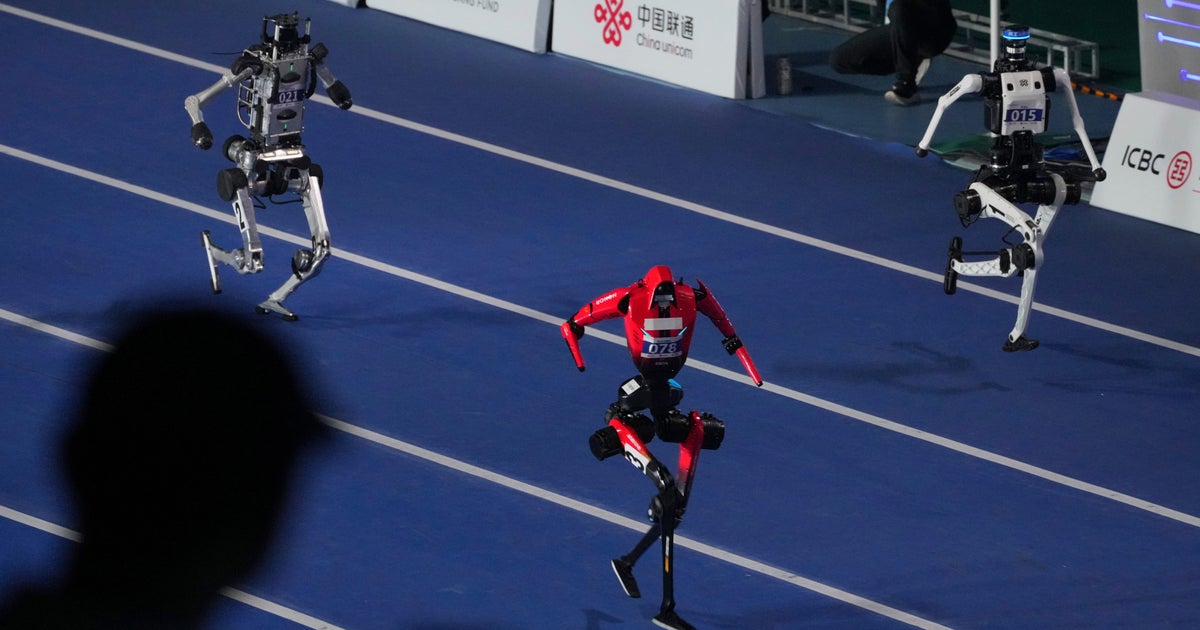
A record that does more than break a number
Beijing staged a scene that would have sounded like science fiction only a few seasons ago: a humanoid robot, built by X-Humanoid, crossing a 100-meter finish line faster than the benchmark set by Usain Bolt, the most towering sprinter the modern track has known. The detail that matters is not merely that a machine ran quickly. It is that the old language of “world record” now has to make room for motors, code, balance systems and a human hand somewhere behind the curtain.
The comparison lands with force because Bolt’s mark has long seemed less like a statistic than a monument. It was the sort of record that felt dug into the bedrock of sport, a number carried by a body of impossible grace and power. A robot stepping into that shadow does not erase the achievement. It reframes it. Sports have always lived beside technology, but this is a different kind of trespass: the finish tape now belongs to a creature built, not born.
The World Humanoid Robot Games are not a gimmick
The event itself, the World Humanoid Robot Games, was designed to showcase exactly this frontier, and that is what makes the result matter beyond the novelty. These games are a laboratory with medals attached. They ask whether humanoid machines can move through a human environment with enough agility to be useful, whether they can compete, adapt and recover in settings that mimic the chaos of real life.
That is the larger story beneath the headline. A 100-meter dash is a clean, brutal test: accelerate, stabilize, endure the load, do not fall apart before the line. For a humanoid robot to manage that at all suggests how quickly the engineering race is moving. It also hints at the new prestige economy around robotics, where nations and companies are not only building tools but staging public proof of mastery. China, in particular, understands the power of spectacle when it is attached to industrial ambition.
This is also why the moment resonates differently from a standard tech demo. No one gathers for a robot to complete a modest task in a lab. They gather to see whether it can do something that, until now, belonged to flesh and tendon and breath. Speed, after all, is one of the oldest sporting languages. We understand it instantly. We can feel it in our ribs.
What Bolt’s standard still means
There is an easy mistake to make here, and it is the one that viral clips often encourage: treating a machine’s accomplishment as a replacement for human excellence. It is not that. Bolt’s 100-meter record, the one set by a man in motion rather than a machine assembled for motion, remains the more profound feat because it was achieved under the oldest and least forgiving conditions—human anatomy, human pressure, human limits.
A robot can outrun a stopwatch. It cannot outrun the meaning of what Bolt did.
That distinction matters. Bolt was not a prototype. He was not calibrated in a workshop. He was a person who took a body with flaws, asymmetries and risk, and made it sing in a straight line. That is why the record still feels untouchable even when a robot appears to beat it in a different, filtered race. The machine may be faster in the narrow arithmetic of the clock. The athlete remains faster in the cultural memory.
And yet, the challenge from robotics should not be dismissed. For decades, we treated athletic records as the outer edge of what a body could do. Now we are watching a different form of organism, one without fatigue and without fear, begin to contest the same symbolic territory. That is both thrilling and a little cold.
My read: this is about humanity borrowing its own myths
I have spent enough years writing about sport to know that every era eventually discovers a new mirror. Sometimes it is steroids. Sometimes it is carbon fiber. Sometimes it is the training table, the biometric vest, the sleep chamber, the algorithm that whispers when to push and when to rest. This time the mirror has joints and servo motors.
What strikes me most is not the speed itself but the theater around it. We keep inviting machines into our most human rituals because those rituals are where ambition becomes visible. A sprint is one of the simplest dramas we have ever staged: start, strain, finish. Put a humanoid robot on that line and suddenly we are asking a larger question without admitting it. If a machine can imitate our most basic expression of urgency, what exactly do we think makes us singular?
The answer, for now, is still unmistakably human. It is not only velocity. It is why we care about velocity. It is the ache of trying, the vulnerability of failing, the grace of winning with a body that can be hurt. The robot’s time may be the number that travels fastest around the internet. Bolt’s record remains the more human fact.
What to watch as the machines keep moving
The next test is not whether another humanoid can post a faster time. Of course one will, eventually. The real question is whether these machines become reliable outside the carefully lit showcase—whether they can run, stop, recover and navigate unpredictability without tumbling into the sort of absurdity that makes a crowd gasp and laugh at the same time.
That is the frontier. Not a single sprint, but durable competence. If the Beijing result feels like a headline from the future, it is because it marks a threshold: the point where robotics moves from demonstration into rivalry, from laboratory curiosity into public comparison. And public comparison is where culture begins to change.
The finish line has not disappeared. It has simply acquired a second meaning. One belongs to the body. The other belongs to the machine. The story from here is watching which one we still cheer for first.
More from Straight From The Bench
Comments
Join the conversation — sign in to leave a comment.
Sign in to commentRelated Stories

Enes Kanter Freedom ejection: Natasha Cloud confrontation explained
Enes Kanter Freedom says a courtside confrontation with Natasha Cloud led to his ejection at a Chicago Sky game. The moment says as much about arena control as it does about the noise around this spor

Caitlin Clark Scores 37: Fever Blow Past Sky 113-90
Clark lit it up for 37, Mitchell poured in 30, and Indiana ran Chicago out of the gym. The Fever are starting to look like a problem nobody wants twice.

Angel Reese Career-High 31 Points: Dream Clinch Playoff Spot
Angel Reese stuffed the stat sheet with 31 points and 14 rebounds as Atlanta sealed a playoff berth with a road win over Phoenix. This one had muscle, urgency, and no shortage of meaning.