
SEC Court Battle: Former NFL Players on College Rosters
The conference is fighting for a hard boundary — and a familiar kind of power.
 Beatrice Kensington6 min read
The SEC is not just defending a rule. It is defending its authority.
The Southeastern Conference has chosen its battlefield with care, and that alone tells you plenty. This is not about one roster spot, one Sunday transplant, or one eccentric loophole in the machinery of college football. It is about who gets to draw the lines, who gets to enforce them, and how much power a conference can still claim in a sport that has spent the last decade prying open its old borders.
A Baton Rouge judge has already put the SEC on its heels, barring the conference from punishing schools that intend to suit up former NFL players this fall. The league, in turn, says it will fight. That response is not surprising. The SEC has spent generations acting less like a collection of schools and more like a governing state, and this case asks it to surrender a piece of that sovereignty. It will not do so quietly.
The real stakes are not philosophical, though they wear that clothing well. The question is whether a player who has signed a pro contract — and then, somehow, finds his way back into a college jersey — can be treated as eligible under the SEC’s own rules, or whether the conference’s punishment power stops at the door of a courtroom. The answer could alter how far conferences can go in policing their membership, especially as NCAA authority weakens and legal challenges keep peeling away old assumptions.
The SEC is not merely arguing eligibility. It is arguing that the right to make the rules still means the right to enforce them.
A fight over eligibility, or a fight over the soul of the system?
The conference’s position is easy enough to understand. If a player has already crossed into pro territory, then letting him return to a college field can feel less like a loophole and more like a breach in the wall. College football has always sold itself on a certain fiction — amateurism dressed in stadium lights and television contracts — and former NFL players re-entering that ecosystem can make the whole structure wobble in plain view.
But the deeper issue is not whether such a player can help a team. Of course he can. The deeper issue is whether conferences are still allowed to write rules with teeth, or whether every penalty is now an invitation to litigation. The SEC has plenty to lose if its disciplinary reach is clipped. If it cannot punish schools for this kind of roster decision, then the deterrent effect of the rule turns into a polite suggestion.
That is dangerous for a league whose identity has long rested on hard edges. The SEC has no shortage of power, but power in the modern college game is increasingly conditional, challenged, and litigated into smaller pieces. Today it is former pro players. Tomorrow it may be transfer restrictions, roster limits, or something else that once felt settled and now looks provisional.
Schools caught between opportunity and exposure
For coaches and athletic directors, the practical problem is simple: talent is tempting, and penalties are expensive. If a former NFL player can help a team in September, there will always be a program willing to ask the awkward questions later. That is the nature of competitive sports. Incentives do not arrive wearing name tags.
This is why the SEC’s battle matters beyond one autumn. If the conference loses the ability to punish teams for using these players, then schools inside the league may begin to treat the risk differently. Some will avoid the headache entirely. Others will see a competitive edge hiding inside legal uncertainty. And once one school tests the boundary, the others will feel the pressure to follow or fall behind.
The most vulnerable people in this arrangement are not the universities at the center of the dispute. They are the athletes, who can become symbols in a legal argument they did not design. Former pros who want another shot at the college game may believe they are reclaiming opportunity. Administrators may see compliance risk. Fans may see either a clever twist or a violation of the sport’s moral furniture. All of them are right, and all of them are missing the larger fact: college football has become a place where every definition is being renegotiated in public.
For readers tracking the broader roster churn across the sport, the SEC’s stance sits in the same family of hard decisions as the ones we’ve been following in the Chiefs’ roster cuts and Carolina’s own trim-down. Different levels, different stakes, same truth: roster control is power.
Why this case feels bigger than the SEC
I have covered enough of these governance fights to know that they rarely begin with the grand language people later assign to them. They start with a roster, a policy memo, a deadline, and a school official trying to make sense of a rule that seemed sturdy until someone challenged it in front of a judge. Then the matter metastasizes. Suddenly the argument is not about one decision, but about the architecture beneath all decisions.
That is where the SEC finds itself now. I would not call this a noble stand, exactly. Conferences do not often sprint toward principle unless principle happens to protect their leverage. But I also would not dismiss the league’s posture as mere stubbornness. There is a genuine administrative danger in allowing each school to improvise around eligibility, especially in a sport already stretched thin by transfer rules, NIL disputes, and the constant erosion of old boundaries.
My view is that the SEC is fighting less to preserve a tidy notion of amateurism than to preserve a chain of command. That may sound cynical, and perhaps it is. Yet chain of command is how college sports have always functioned when they functioned at all: universities to conference, conference to NCAA, NCAA to court, court to chaos. Every time one of those links weakens, the whole structure has to explain itself again.
And that is what makes this worth watching. If the SEC loses, it will not simply be because one judge favored a particular roster argument. It will be because the old presumption — that a conference can impose consequences and expect obedience — has become harder to defend in a legal era that mistrusts inherited power.
What to watch as the SEC pushes back
The next step is about more than legal filings. It is about whether schools inside the conference begin planning around a new reality or waiting for the old one to return. The interim period matters. In sports, uncertainty is never neutral. It changes recruiting conversations, compliance decisions, and the quiet little calculations made in offices where no one wears a jersey but everyone shapes one.
Watch, too, how other conferences respond. If the SEC cannot police this rule, it may encourage copycat challenges elsewhere. College football is always quickest to imitate a loophole once somebody proves the door opens.
The sport does not lack for talent or theater. What it lacks, increasingly, is clarity. And this case is another reminder that the most consequential battles in college football are no longer being decided on the field.
They are being argued over who gets to control the field in the first place.
More from Straight From The Bench
Comments
Join the conversation — sign in to leave a comment.
Sign in to commentRelated Stories

North Dakota State FBS Debut: Bison Win First Game
North Dakota State walked into its FBS debut and looked like it had been here for years. The Bison didn’t blink, and that’s the real story.

College Football Week 0 Scores: UNLV vs. Memphis Live Updates
Week 0 is here, and the first real clues are already on the board. North Carolina’s win over TCU set the tone, and UNLV vs. Memphis closes the night with more to prove than polish.
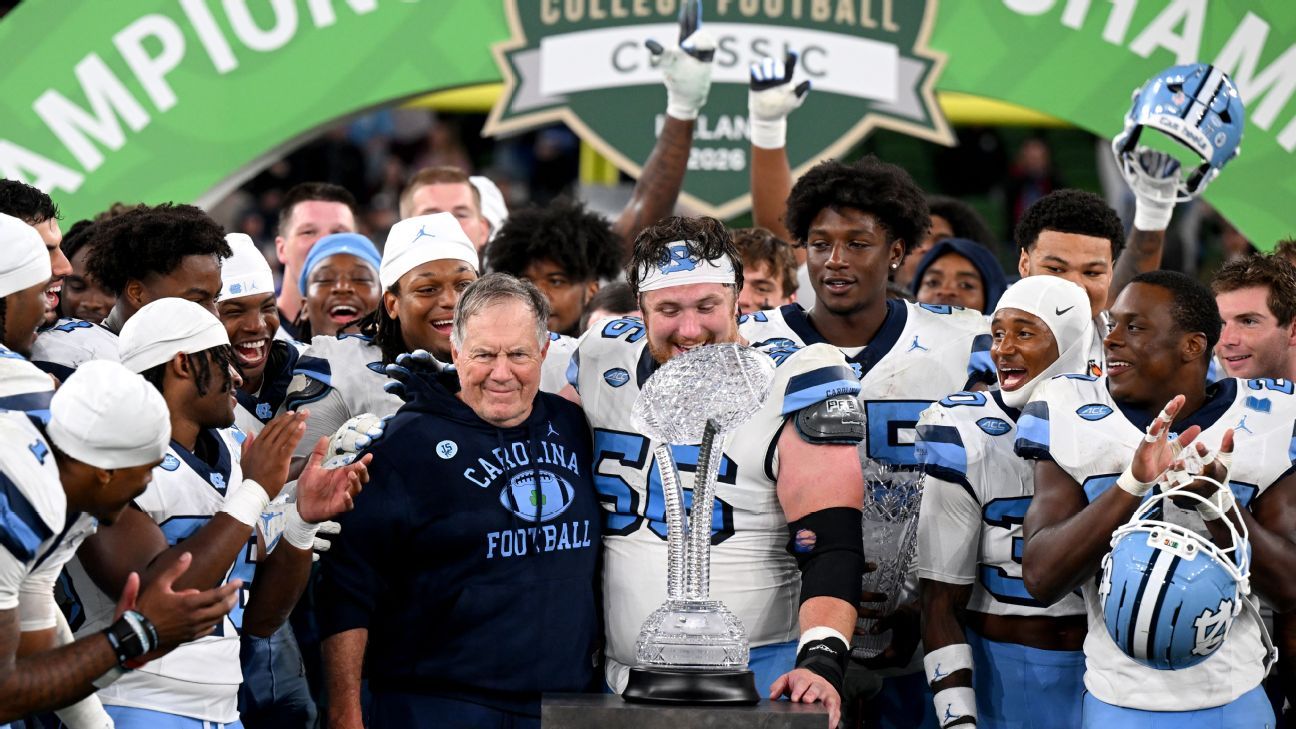
UNC vs TCU Football: Bill Belichick’s Tar Heels Look Improved
College football’s opening act in Dublin carried more than novelty. It offered the first public glimpse of Bill Belichick’s North Carolina project, and the early read was simple: better, sturdier, mor