
World Cup 2038: Trump Pushes U.S.-Only Host Bid
A stadium dream, a diplomatic snub, and the politics of who gets a seat at the table.
 Beatrice Kensington5 min read
The World Cup has always been a tournament of flags, but it is just as often a tournament of egos. Now, with the next men’s bidding horizon still distant, the United States has been pulled back into the old and uneasy theater where sport and power share the same stage. Donald Trump’s desire to see the U.S. host another FIFA World Cup — this time apparently without its North American partners, Mexico and Canada — is less a scheduling note than a political signal, and signals have a way of casting long shadows.
There is a reason this matters beyond the ceremonial glow of opening-night fireworks. The modern World Cup is not merely a month-long pageant of goals and anthems; it is infrastructure, diplomacy, branding, and an argument over whose version of global belonging gets to be celebrated under the same television lights. A joint 2026 tournament across the United States, Mexico, and Canada was meant to symbolize continental cooperation. The idea of an American-only bid for the next available men’s tournament cuts the ribbon off that symbol and hands it to politics.
The politics behind the pitch
Trump’s talk about the U.S. hosting again, and his suggestion that FIFA’s president floated a U.S.-China co-hosting idea, lands in a familiar place: sport as a stage for national vanity. Hosting the World Cup is never just about the game. It is about airports, security, public money, city contracts, labor, and the soft power of being seen as the country that can hold the world in its palm without dropping it.
In soccer, hosting rights are never just about soccer. They are a ledger of influence.
And this is why the notion of excluding Mexico and Canada is so striking. The North American partnership for 2026 was already a rare achievement in an era when international cooperation is often treated like a museum piece. To envision the U.S. going it alone next time is to trade the language of shared continent for the sharper tongue of national preference. It may be technically possible, but it is not culturally innocent.
What a U.S.-only bid would really mean
The next men’s World Cup available for bidding is not around the corner; it lives on the far edge of the calendar, in the 2030s, where plans become more fantasy than fixture. That distance matters. It gives policymakers time to change, federations time to maneuver, and public attention time to drift. But it also means the shape of the bid becomes a preview of the geopolitical mood that will greet it.
A solo U.S. bid would likely be sold as efficiency, clarity and control. One nation. One bureaucracy. One set of standards. One narrative. Yet the World Cup has grown precisely because it is not confined to a single national frame. The shared hosting model has become FIFA’s way of spreading the burden and the reach, letting the tournament bloom across borders instead of trapping it inside them.
For the United States, the upside is obvious: more marquee matches, more tourism, more stadium revenue, more chance to keep pushing soccer deeper into the country’s sporting bloodstream. The downside is subtler. A solo bid can look less like partnership and more like ownership. And ownership, in global sport, is rarely a harmless word.
China, cooperation, and the long game
The mention of a U.S.-China co-hosting idea adds another layer of unease. Soccer has always been fascinated by scale, and China remains one of the sport’s great unfinished commercial stories. But a World Cup bid involving China would carry enormous political baggage, from human rights scrutiny to broader strategic rivalry. In another era, that would have sounded like an audacious business proposal. In this one, it sounds like a diplomatic gamble with stadium lights.
The larger point is that FIFA’s future hosts are being discussed less as sporting partners than as geopolitical instruments. That does not mean the games themselves lose their magic. They do not. The first touch, the late equalizer, the final whistle — those still belong to the players. But the apparatus around them is becoming increasingly hard to ignore, because the apparatus determines who gets access, who gets prestige, and who gets told they are welcome.
As someone who has watched major sporting events drift steadily closer to the machinery of statecraft, I find this development both inevitable and faintly depressing. The World Cup used to be framed, at least in public mythology, as a festival of nations meeting in peaceful competition. It still is that, in part. Yet each new bid seems to arrive carrying a heavier suitcase: lobbying, image management, and the relentless urge by governments to use a ball and a banner to say something grand about themselves. The ball, of course, never says thank you.
I suspect the most honest reading is this: a U.S.-only World Cup bid would be less about soccer’s needs than about a certain political imagination of America’s place in the world. It would ask FIFA to affirm a hierarchy, not just a host. And FIFA, which has spent generations proving how readily it can confuse cash flow with wisdom, may listen.
The 2026 shadow and what comes next
The 2026 tournament still has to play out, and its success or failure will shape every future conversation about North American hosting. If the event is smooth, crowded and commercially booming, the case for more American mega-events grows stronger. If it is chaotic, expensive or politically noisy, the appetite for repeating the exercise could cool.
That is the part that should interest fans, not just officials. These bids are not abstract, and they are never far removed from the lived experience of the people who fill the stands, work the venues, or shoulder the costs in the host cities. A World Cup can leave behind pride, infrastructure and a new generation of believers. It can also leave behind debt, displacement and a lot of glossy promises that do not survive the final weekend.
The next battle will not begin with a kickoff. It will begin in boardrooms, in ministries, in federation meetings and in the language of “legacy” that always sounds nobler than the invoices it will eventually explain.
The game will go on. The bidding war already has.
More from Straight From The Bench
Comments
Join the conversation — sign in to leave a comment.
Sign in to commentRelated Stories
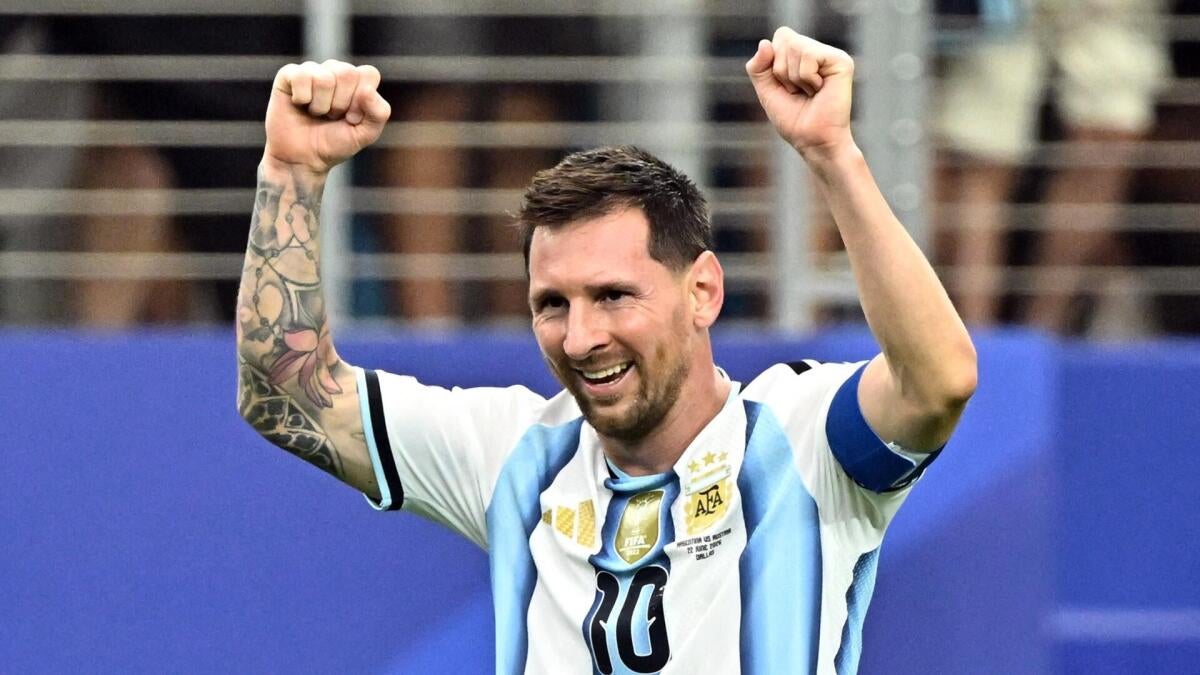
Argentina vs. Spain World Cup Final: Messi vs. Yamal
Argentina and Spain meet for the 2026 World Cup crown, with Lionel Messi chasing another summit and Lamine Yamal trying to kick the door down.

World Cup Halftime Show: How MetLife Will Protect the Grass
MetLife Stadium is about to host a halftime show that has to move like a road crew and leave the pitch untouched. In soccer, the grass is the star.

England vs France World Cup playoff: Tuchel sees scars
Thomas Tuchel says England are still carrying the bruises of their World Cup exit. France are the opponent, but the real battle is inside the dressing room.