
Arkansas basketball vs. Bahamas: Razorbacks' turnover-fueled rout
A summer workout, yes. Also a warning label and a blueprint.
 Beatrice Kensington6 min read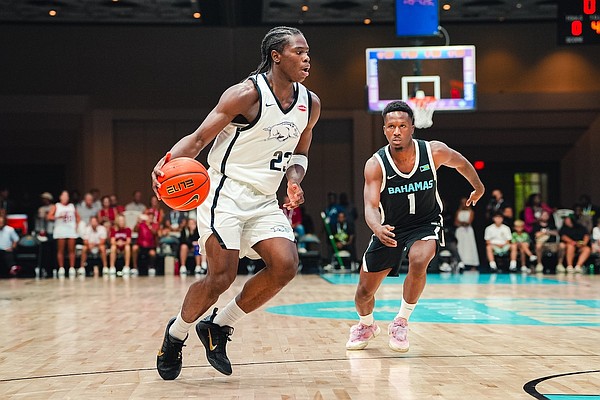
NASSAU, Bahamas — The scoreboard said 106-59, but the more revealing figure was the one buried inside the box: 26 turnovers forced. That is not merely a tidy summer statistic. It is the outline of a team deciding, early and loudly, that it intends to make life miserable for the people across from it.
Against the Bahamas national team at the Baha Mar Convention Center, Arkansas basketball did what good programs do when the talent gap is wide and the setting is soft around the edges: it imposed its will, kept its hands active, its legs moving, and its attention fixed. Thirteen blocks completed the picture. The Razorbacks were not just bigger. They were busier. They were nastier in the right way.
Defense was the headline, and it should be
This was summer basketball, which means caution is required before anyone starts engraving slogans into marble. But some habits travel. Defense travels. Effort travels. The willingness to turn a casual possession into a trap, then turn that trap into a layup, travels even farther.
For Arkansas, the 26 forced turnovers mattered because they suggested more than athletic superiority. They suggested connectivity. One defender pressures the ball, another steps into the passing lane, a third rotates to erase the rim. That is not random energy. That is structure. And when a team is producing 13 blocks on top of that, the message is plain: the paint is going to feel crowded all year.
In the NCAA game, especially in a league where March rewards patience and punishes sloppy guards, that sort of defensive edge can be worth more than a pretty offensive set. It shortens games. It rattles poise. It gives lesser shooters second thoughts. Arkansas has long had stretches where it looks physically imposing. The question has always been whether that force could become discipline. A result like this at least suggests the tools are there.
What a 47-point margin can and cannot tell us
A lopsided exhibition can flatter nearly everyone involved. The larger team runs. The smaller team tires. The whistles are different, the pace is different, and the emotional stakes are nowhere near what they will be in November. So no, this is not a prophecy. It is a sample. A useful one, but still a sample.
Even so, the specific nature of the win matters. Arkansas did not merely outscore the Bahamas; it created extra possessions, and extra possessions are the currency of modern basketball. A team that can turn defense into offense without waiting for the half-court to hum is a team that can survive dry spells, foul trouble, and the inevitable nights when the jumper has gone missing and left no forwarding address.
That is why this kind of summer showing is more than an exercise in optimism. It hints at identity. Arkansas appears to want to be long, aggressive, and relentless, the sort of team that makes the rim feel guarded by weather. That can be a potent proposition in the Southeastern Conference, where size and pace often collide with a vengeance.
The players who benefit from a game like this
The obvious beneficiaries are the newcomers and the young players trying to earn trust. Summer trips are auditions as much as they are tune-ups. Coaches learn which players sustain effort when the script starts to wobble, which ones talk on defense, which ones rebound as a habit rather than a gesture.
A game like this also helps the veterans who may be asked to anchor Arkansas when the calendar turns and the pressure rises. It is one thing to preach defensive urgency in practice. It is another to watch the ball get stripped, the shot get altered, and the bench rise because everybody can see the cumulative effect. Those are the moments that build collective belief.
Arkansas did not just win a game in Nassau. It showed the shape of a team that expects opponents to pay for every lazy pass and every late closeout.
I keep coming back to that number, 26 turnovers, because it speaks to a style that can survive bad shooting. In my years watching college basketball, the most dependable teams have not always been the prettiest ones. They have been the ones that treat every possession like a small legal proceeding, with no easy exits and no casual assumptions. That is where Arkansas could be dangerous if this becomes routine rather than a one-day flourish.
There is also a broader cultural layer here, one that programs with national ambition understand well. Summer overseas trips are not just about bonding or sightseeing or a few clips for the highlight package. They are about teaching a roster how to look and sound like a team before the games count. The best ones return home with sharper edges and quieter uncertainty. The worst ones return with photographs.
Arkansas seems intent on being the former. If you want a reminder of how much these trips can mean, compare them with other programs trying to define themselves in public, from the noise around Cowboys trade rumors in another sport to the way every small sign gets inflated into doctrine. College basketball is no different. Fans are starved for clues. Coaches are hunting for habits. Everyone is reading tea leaves in broad daylight.
The summer trip's real value is the standard it sets
The real test is not whether Arkansas looked dominant against the Bahamas national team. It did. The real test is whether this game becomes a floor instead of a ceiling.
Can the Razorbacks defend with this kind of vigor against a ranked opponent in January, after a rough road trip and an ugly shooting night? Can they keep the ball in front of them when an SEC guard starts dancing at the top of the arc? Can their rim protection remain a feature, not a flourish? Those are the questions that will decide whether this performance becomes a memory or a marker.
For now, the answer is encouraging. Arkansas found a way to combine length, pace, and pressure into something that looked coherent, which is never a small thing this early. The scoreboard was lopsided, yes, but the most meaningful part was the tone. The Razorbacks played like a group that had already agreed on the terms.
That is the sort of thing a season can be built on.
The next step is the harder one: proving it was no accident.
More from Straight From The Bench
Comments
Join the conversation — sign in to leave a comment.
Sign in to commentRelated Stories
Michael Lombardi UNC Investigation: Attorney Pushes Back Hard
UNC’s investigation into Michael Lombardi has turned into a paperwork war as his attorney fires back. The longer it drags, the more it stains the program.

Cowboys trade rumors: Stephen Jones weighs big-name veteran moves
Stephen Jones says the Cowboys are looking at trades and veteran additions. That means Dallas isn’t done tinkering with a roster that’s already been rebuilt once.
Curt Cignetti Indiana Schedule: SEC Shot Meets Soft Slate Reality
Curt Cignetti took aim at the SEC, but the schedule conversation came right back to Indiana. The noise is loud; the résumé still has to show up.