
Aryna Sabalenka US Open: Cannabis Smell Halts Match
New York got loud, then got weird. Sabalenka stayed sharper than the air around her.
 Zane Miller5 min read
Aryna Sabalenka did what top seeds are supposed to do in New York: she absorbed the chaos, made her point, and kept moving. A brief stoppage over a strong cannabis smell in her match against Kamilla Rakhimova could have turned into a whole afternoon of distraction. Instead, it turned into a footnote on the way to the US Open) fourth round.
That’s the Sabalenka story in a nutshell right now. Something odd happens, something noisy happens, and she still ends up looking like the player with the clearest head on the court.
Sabalenka stopped play, then took back control
The smell issue was real enough to halt play for a moment, and in a tournament like this, that matters. Tennis is built on rhythm. Serve clock, breathing, between-point routine, crowd noise, momentum swings — all of it is part of the job description. When that gets interrupted, especially in a packed New York setting, the player who resets fastest usually benefits.
Sabalenka didn’t need much time. She raised the issue, play paused, and then the match resumed with her still doing what she does best: dictating. Power, pace, first-strike tennis. Rakhimova was never really allowed to settle into the match long enough to make the moment matter.
That’s the larger takeaway here. The disruption was notable, sure, but the bigger headline is that Sabalenka stayed on script. Top players are not just judged on how they play when everything is clean. They’re judged on how quickly they can clear clutter out of the way.
Why the environment in New York keeps becoming part of the story
The US Open) is the loudest major on the calendar and usually the most unpredictable. Open-air courts, massive foot traffic, constant city energy. It’s a tournament where the surroundings are never just background. They’re part of the match.
That’s one reason this moment hit a nerve. Tennis players are obsessed with control, and the US Open keeps offering them reminders that control is always partial. Noise from the stands, wind, heat, schedule compression, and now the occasional off-court smell problem — it all chips away at the illusion that this is a perfectly sealed environment.
For the governing bodies, this is not a tiny detail. If players are stopping play because a smell is strong enough to affect concentration, someone in the tournament ecosystem has to treat it as more than a joke. Athletes need a consistent competitive environment. The biggest stages should feel premium, not random.
Sabalenka didn’t let the moment become the match. That’s what elite players do.
What this says about Sabalenka’s place in the draw
Sabalenka is built for this tournament. The hard courts reward first-strike aggression, and she has the kind of heavy power that can shorten rallies before opponents ever get comfortable. That style also travels well through weird moments. If the match gets ugly, she can still win ugly. If the court gets loud, she can still out-hit the noise.
That matters because the second week of a Slam is less about highlight shots and more about emotional efficiency. You don’t win a major by playing perfect tennis every set. You win by handling the small disruptions better than everyone else. On that front, Sabalenka checked the box.
And this is where the draw starts to tilt. Once the top seed keeps surviving without burning extra energy, the rest of the field feels it. Everyone in her quarter has to budget for the fact that she’s still there, still serving first, still creating scoreboard pressure from the opening games.
If you’ve been following the women’s side all season, this lines up with the broader picture. Sabalenka is one of the few players who can enter a match with the kind of physical edge that forces her opponent to play almost perfectly. That’s why her path at majors often feels less like a chess match and more like a weather system rolling through.
The first-person read: this is the kind of moment champions should love
I’ve always thought there’s a quiet telling detail in these stoppages: the great ones almost seem to welcome the interruption if it gives them a second to re-center without losing authority. Sabalenka didn’t look rattled by the pause. She looked mildly annoyed, which is exactly where she should be. Annoyed means engaged. Annoyed means the match still belongs to her.
That’s the part I’m paying attention to going forward. Not the smell. Not the bizarre New York side note. The signal. Sabalenka is showing the kind of tournament temperament that wins in late August and early September, where the margins get tighter and the noise gets louder. If you want a historical parallel, think less about elegance and more about survival. The champions in this event rarely have the cleanest week. They have the strongest spine.
And if you’re an opponent watching this bracket, that’s the problem. Even when the match gets interrupted by something nobody trains for, Sabalenka still looks like the most settled player in the building. That’s a bad sign for everyone else.
For another elite-player pressure point, the conversation around Caitlin Clark’s Team USA bench role showed how much attention follows stars even when the stat line isn’t the main event. Different sport, same reality: the spotlight changes the temperature.
Sabalenka now moves on, and the field keeps shrinking. The strange moment is already fading. The contender is not.
More from Straight From The Bench
Comments
Join the conversation — sign in to leave a comment.
Sign in to commentRelated Stories

Nick Kyrgios ban: Australian cleared to return after cocaine case
Nick Kyrgios is eligible to return after serving a one-month ban for a positive cocaine test. The tennis showman is back, but the questions never really left.

Taylor Fritz US Open 2026 Live Coverage: What’s at Stake
Taylor Fritz is back in the US Open spotlight as the tournament rolls on in New York. The draw, the pressure, and the home-crowd noise all start to matter now.
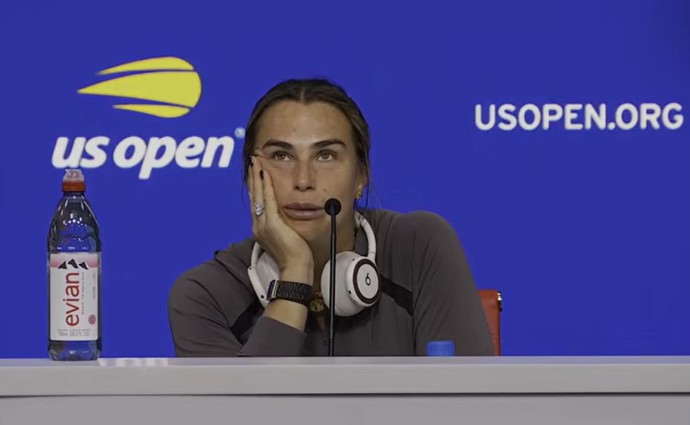
Aryna Sabalenka US Open Media Questions: Partying, Next Question
Sabalenka bristled at being asked if sponsor events and social time hurt her US Open prep. Fair enough. The racket, not the party, still decides matches.