
Tadej Pogačar European Championships: Slovenia’s line-up loses its brightest star
Without Pogačar, the race changes shape — and so does Slovenia’s ceiling.
 Beatrice Kensington5 min read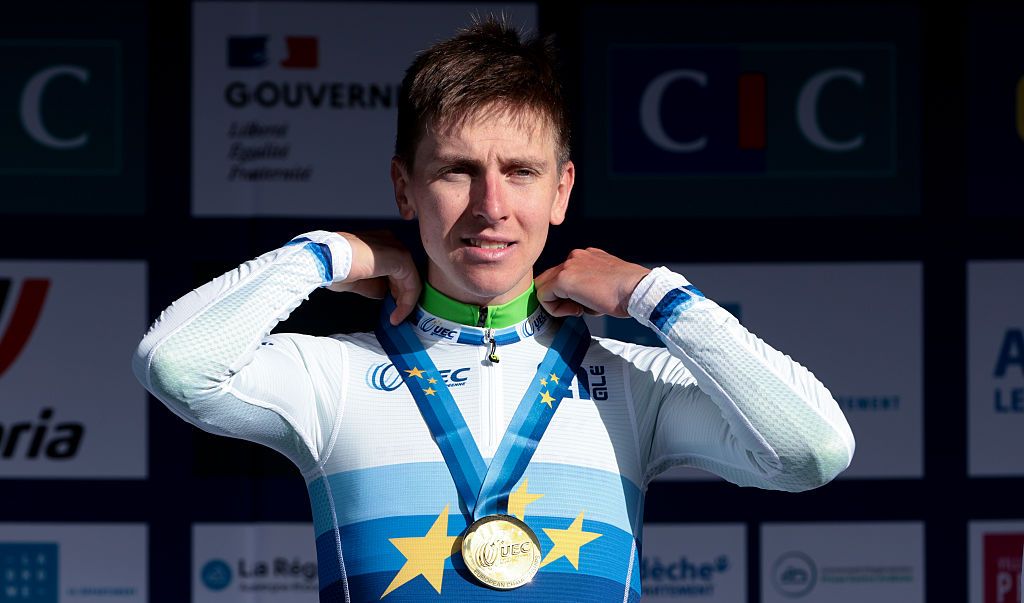
The cleanest thing about a list is that it tells the truth without ceremony. Slovenia’s roster for the UEC Road European Championships is now set, and the name that rearranges the entire sport’s weather system is absent. Tadej Pogačar will not be there. Not in the road race, not in the background, not as the silent threat who turns every tactical plan into a prayer.
That absence matters because Pogačar is not merely Slovenia’s best rider; he is the rider around whom modern road racing so often bends like grass in a hard wind. Strip him from the equation and the event loses a layer of suspense, yes, but it also reveals something starker: even a nation with two titans, Primož Roglič and Matej Mohorič, is still different without its singular force.
Slovenia’s new shape without its brightest light
This is not a tragedy for Slovenia. Let us not pretend otherwise. A team led by Roglič and Mohorič is still a frightening proposition, seasoned with climbing legs, tactical cunning and the kind of race-hardening that only years at the sharp end provide. Roglič remains one of the most complete stage racers of his generation, a man who can sharpen a final climb into a guillotine. Mohorič, meanwhile, is the sort of rider who can turn a selective race into a strange and beautiful mess.
But Pogačar changes the arithmetic. He changes who chases, who hesitates, who burns matches too early because they fear the inevitable later. Without him, Slovenia becomes a more conventional force — still dangerous, less gravitational.
That is the quiet consequence here. The confirmed line-up does not just tell us who is riding. It tells us how the race will breathe.
Roglič and Mohorič inherit the burden, and the freedom
There is an odd liberation in losing the obvious favorite. Roglič no longer has to live in the long shadow of a teammate whose exploits spill beyond cycling and into folklore. The burden of being the automatic answer shifts. So does the tactical burden. In a race of this kind, one missing star can transform a team from hunted to opportunistic.
That does not mean the road grows kinder. It means the script does. Slovenia can now race with more ambiguity, perhaps even with more patience. Roglič’s temperament has long invited suspicion and admiration in equal measure; he is at his best when the race narrows and the road begins to tilt. Mohorič brings a different kind of menace, one built on daring and timing rather than brute inevitability.
Pogačar’s absence does not merely weaken Slovenia. It removes the race’s most convenient excuse for everyone else.
There is also the human side, the part polished through public fascination and rarely handled with care. Injuries are not just calendar issues; they are interruptions to rhythm, to identity, to the private structure elite athletes build around peak form. The rumor mill always wants a comeback story, especially when the rider in question is as magnetic as Pogačar. But bodies do not care about storylines. They ask for time. Sometimes they refuse it altogether.
The bigger picture: a race that must stand on its own
I have always believed the most interesting championship races are the ones that survive the absence of the obvious star. A great event should not require a single sun to explain its daylight. Pogačar is one of those rare cyclists whose presence can make a course feel mythic before the peloton has even clipped in. Yet the sport cannot build every marquee event around one face, however luminous.
This is where cycling’s deeper health is tested. If a European Championship collapses into lesser significance because one rider sits it out, then the event is too dependent on celebrity and not enough on the layered drama of national rivalry, course design and late-race nerve. Slovenia’s confirmation without Pogačar reminds us that the race must now earn its tension elsewhere — through Roglič’s calculation, through Mohorič’s audacity, through the responses of France, Belgium, Italy and the rest of the field.
I say that as someone who admires the sport’s stars and still mistrusts its habit of reducing everything to star presence. Cycling is bigger than that, or should be. The roads, the weather, the positioning, the timing, the punishing arithmetic of one bad corner or one uncooperative climb — these are the true authors. The champion merely signs the page.
What to watch now that the favorite is gone
The first thing to watch is whether Slovenia commits fully to a Roglič-centered plan or plays the more elastic card, using Mohorič as a late-race disruptor. That choice will tell us whether the team sees this as a title opportunity or a race to survive with pride intact.
The second is how the rest of the field recalibrates. Pogačar’s absence invites boldness from riders who might otherwise have spent the day marking one another for his eventual move. A race without the overwhelming favorite can become more open, but also more reckless. Open roads make for brave attacks. They also make for stupid ones.
And finally, there is the simple question of expectation. Slovenia remains dangerous, but it is no longer inevitable. That may suit them just fine. The most compelling teams are not always the loudest ones; sometimes they are the ones forced to think their way through the noise.
The European Championships will go on without Pogačar, and perhaps that is the point. The race now belongs to the riders who are still there. The rest is weather.
More from Straight From The Bench
Comments
Join the conversation — sign in to leave a comment.
Sign in to commentRelated Stories

Esteban Ocon Haas split: F1 future suddenly in doubt
Haas is moving on from Esteban Ocon after the season, and that changes his whole leverage map. In Formula 1, timing is half the battle — and his clock just got louder.
Brad Keselowski RFK Racing Ford Departure: What 2026 Means
Brad Keselowski will leave RFK Racing’s No. 6 Ford after 2026, setting up a long goodbye and a rare, deliberate transition in NASCAR.

Manchester City Financial Charges: Micah Richards Reacts
Micah Richards says he was devastated by the Premier League’s damning ruling on Manchester City’s charges. That reaction says plenty about how deep this mess runs.