
Tyreek Hill Personal Conduct Policy Investigation: What It Means
The knee may be the football story. The conduct file is the one that shadows everything else.
 Beatrice Kensington6 min read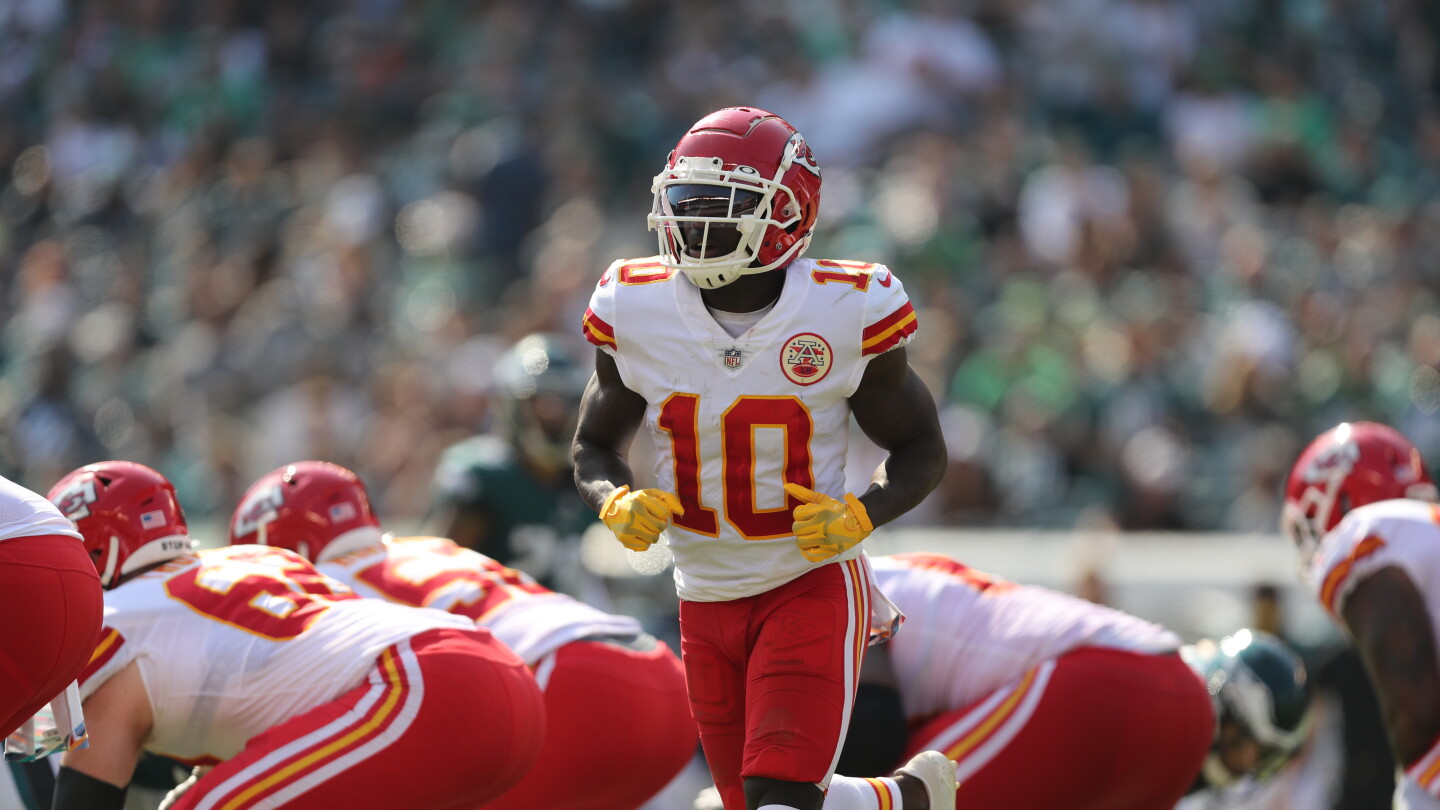
Tyreek Hill has always been the kind of player who bends the geometry of a football field. He stretches safeties, alters coverages, turns routine snaps into emergency response. But the present force around him is not speed. It is suspense. And it has nothing to do with his route tree.
The Chiefs rumor mill, the knee chatter, the familiar hum of a possible reunion — all of that can pull the eye. Yet the detail that hangs heaviest is the one that lives off the turf: Hill remains under an active NFL Personal Conduct Policy investigation, and that means any team considering him is not merely evaluating a receiver. It is weighing timing, optics, and the league’s appetite for seeing this matter back under the spotlight.
The football fit is the easy part
Hill’s value has never been subtle. He is not a possession receiver in the old sense, a man meant to gather eight yards and disappear into the background. He is a structural event. Defenses adjust their posture the moment he lines up. Safeties drift. Corners cheat. Play-callers leave useful plays in the drawer because one man has changed the arithmetic.
That is why the football conversation can become so seductive, so quickly. A team can convince itself that if the knee holds, if the timing works, if the chemistry returns, then the problem is solved. But the NFL is never that clean, especially with a player whose profile comes with baggage that does not stay politely in the rearview mirror.
The league has spent years trying to present discipline as architecture — a set of rules, processes, and consequences that stand apart from the weekly theater of games. Yet the truth is more awkward. The moment a player is useful enough, the questions about character become less academic and more operational. Coaches want to know whether they can build around him. Front offices want to know whether they can sell him. Ownership wants to know whether the building burns hotter if he walks through the door.
An investigation that changes the calculus
An active investigation is not the same as a final ruling, but it is not wallpaper either. It leaves a team in a kind of administrative fog. A signing can feel bold one day and reckless the next, depending on what the league chooses to do and when. That uncertainty has a way of chilling enthusiasm in the rooms that matter most.
The NFL has lived through this tension before, and never elegantly. When a player’s on-field merit is loud enough, the league’s off-field standards often arrive belatedly, after the marketplace has already begun setting the terms. That is how these episodes tend to work: the talent gets the first word, the policy gets the last. Sometimes much later.
For Hill, the significance is obvious. If he is indeed nearing a signing, the investigation is no longer a background note. It becomes part of the transaction. Every interested club has to ask how much risk it is willing to absorb for the sake of explosive production and immediate relevance. A playoff contender may shrug at turbulence. A franchise trying to steady itself may not.
And the league, for its part, will not want this becoming an argument about selective seriousness. Consistency is the rarest commodity in professional sports discipline, more scarce than cap space in March and patience in October.
Talent can buy you a bigger stage. It does not buy you a clean ledger.
The human cost that sits beneath the roster move
It is easy, in the churn of football life, to reduce a player to a depth chart slot or a number beside his name. That is how the business prefers it. The body of work. The market value. The production. But the public does not absorb these cases as spreadsheet entries. It reads them as a test of what a league will tolerate, and what teams will excuse when the reward is large enough.
That is especially true with Hill, whose career has always carried a sharper edge in the public imagination. He is a brilliant player and a complicated figure, and those truths do not cancel one another out. They coexist, uneasily. The league knows this. So do the clubs considering him. So do the fans, who have become both more cynical and more morally exacting in the same breath.
This is where the current moment becomes larger than one receiver’s availability. A team that signs Hill is making a football decision, yes, but also a cultural one. It is signaling what kinds of risk it can live with, what kinds of scrutiny it expects, and how much faith it places in the idea that winning can absorb almost anything.
I have watched enough of these cycles to know the bargain is often poorly understood. Teams think they are purchasing only yards after the catch. What they are really buying is attention — the kind that lingers after the game film has been filed away. I have seen this movie before, in different uniforms and different cities, and it always arrives with the same old confidence: we can handle it. Sometimes they can. Often they cannot.
The larger NFL story here is not just about Hill’s case. It is about how quickly the sport reverts to appetite. A player becomes available, the tape looks good, the need feels urgent, and the rest of the machinery starts to hum. But there is a difference between a roster need and a moral vacuum. Teams blur that line at their own peril.
What to watch if a signing comes quickly
If Hill lands somewhere soon, the first thing to watch will be the league’s pace. Does the investigation accelerate, stall, or somehow drift into one of those bureaucratic stretches where everyone waits for someone else to make the first official move? The second thing will be how the team talks about him. Language matters. “Due diligence” can sound like accountability or camouflage, depending on the speaker.
Then there is the locker room question, the one front offices often underestimate. A star receiver can lift an offense, but he also reshapes the emotional center of the room. Younger players notice what a franchise will stomach. Veterans notice what it will explain away. The coaching staff may spend the first week drawing up third-down routes and the next one managing the social weather.
For readers trying to keep score, the on-field arithmetic remains simple. Hill would still be Hill: fast, dangerous, difficult to defend. But the off-field ledger is not so tidy, and it is the one that determines whether this becomes a football story or something far more enduring.
The next move will tell us whether the league and its teams have learned to treat scrutiny as seriously as speed. I would not bet on it.
More from Straight From The Bench
Comments
Join the conversation — sign in to leave a comment.
Sign in to commentRelated Stories
Buccaneers Coaching Change: Todd Bowles Is Running Out of Time
Tampa Bay’s season has gone sideways fast. The Buccaneers are 2-11 since starting 6-2, and Todd Bowles is staring at a brutal finish.
Dre Greenlaw Sean Payton: Broncos sideline disrespect fuels 49ers
Dre Greenlaw said Sean Payton’s sideline stunt lit a fire under him, and the 49ers linebacker played like it. In the NFL, sometimes the petty stuff is the real fuel.
Chiefs Receiver Woes: Rashee Rice Injury and Lamar Jackson Update
Kansas City’s thin margin on offense just got thinner, while Baltimore waits on Lamar Jackson and hopes the floor does not fall out beneath it.