
Athletics Shea Langeliers Meniscus Injury: 2026 season blow
Oakland’s catcher was the lineup’s spine. Now the calendar just got mean.
 Zane Miller5 min read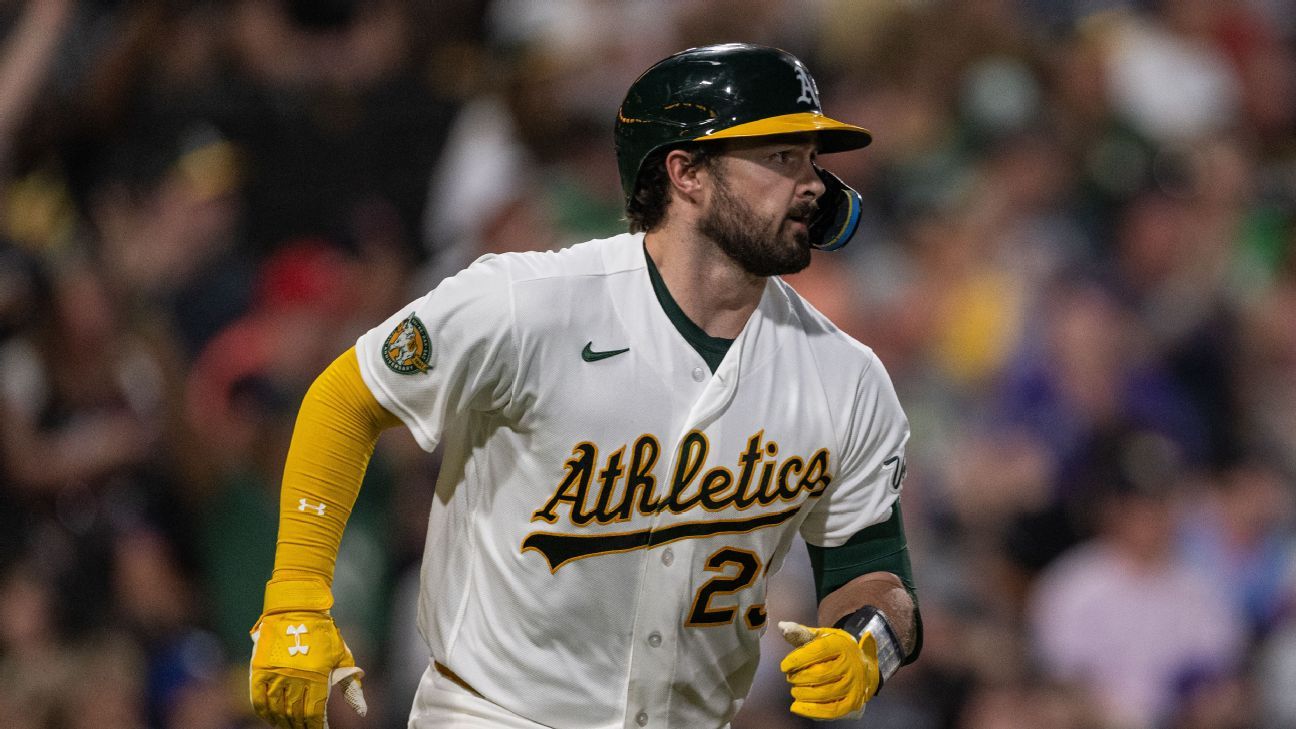
Shea Langeliers was one of the few pieces in this Athletics lineup you could actually build around without squinting. Now the right knee meniscus tear turns a steady anchor into another hole, and if the reporting holds, the kind of hole that can swallow most of a season.
This is not just a catcher going down. This is the All-Star catcher, the everyday bat behind the plate, the guy who gave a young roster some muscle and a little legitimacy. Lose that, and suddenly the A’s are doing the ugly math every front office hates in late summer: how many games can we survive without our most dependable catcher, and how much offense disappears when the position no longer hurts opposing pitchers?
The injury hits the one spot Oakland can’t easily patch
Shea Langeliers matters because catcher is not a plug-and-play position, especially for a team that already lives in roster triage. You don’t replace his innings with a warm body and call it fine. You replace the receiving, the game-calling, the power, the presence, the leverage he gives the rest of the order.
The Athletics have spent enough seasons in talent rationing to know how brutal this gets. A torn meniscus in the right knee can be manageable for some players, but for a catcher it’s a nasty business. Squatting, popping, lateral movement, transfers, the whole load-bearing nightmare of the position — everything asks for more than a knee wants to give.
That’s the part that makes this more than a simple injury note. Catchers wear damage for a living. When one of the better offensive catchers in the league goes down, you are not just losing a name on a lineup card. You are losing the daily grind guy who helps stabilize the entire operation.
A lineup already short on margin just lost more power
The A’s have been operating with very little room for error, and this pushes them even closer to the edge. They were already a team trying to manufacture innings, patch holes, and hope the younger pieces grow up on schedule. Now they may have to do it without one of the few players who could punish mistakes and keep pitchers honest.
That changes the opposing game plan immediately. Teams won’t pitch to the A’s the same way without Langeliers looming in the middle. That’s not poetry, that’s roster reality. Remove a real bat and the rest of the lineup gets pitched differently. Fewer mistakes in the zone. More nibbling. More pressure on the on-base guys to actually get on. Suddenly every run becomes a negotiation.
And for a club that is already dealing with broader injury pain, this one lands like a second shoe. The front office can talk flexibility and opportunity all it wants. Losing one of your best players is how flexibility becomes desperation.
The catcher market is thin, and the calendar is not kind
This is where the roster-building lesson gets loud. Catching depth is always scarce, and quality catching depth is even scarcer. If a team has it, it hoards it. If it doesn’t, it spends months pretending the next man up can hold the fort.
That’s why Langeliers’ injury carries weight beyond Oakland. It exposes how fragile a team gets when one premium position is tied to one premium player. The system can survive a corner outfielder injury better than it survives a catcher injury. You can shuffle outfielders like deck chairs. You do not casually replace a catcher who also supplies middle-of-the-order pop.
The timing is ugly, too. Late-season injuries don’t just test depth; they test organizational honesty. Is the club still pretending it can climb back into something meaningful, or does this send it fully into evaluation mode? Because once your All-Star catcher is out for the remainder of the year, the conversation shifts fast from winning now to surviving the next wave of bad news.
What this says about the A’s bigger picture
I’ve said this for years: rebuilding teams usually don’t get to choose their injuries. They just get measured by how well they absorb them. And that’s the difference between a competent rebuild and one that turns into a year-long shrug.
Losing your catcher is bad. Losing your best catcher, and maybe your best overall everyday offensive catcher, is organizational stress testing.
The Jeff Kent Hall of Fame piece I wrote recently was about the value of overlooked production — the kind of player whose impact is obvious only when he’s gone. Langeliers fits that lane, except he’s doing it in real time, and at a far more fragile position. Teams love to talk about depth until depth has to play every day and the results stop looking theoretical.
My read? This could force the Athletics to make a decision on how aggressively they protect what’s left of the roster versus trying to squeeze value out of a compromised season. The line between development and damage control gets very thin in moments like this. And if you are in that building, you are probably not thinking about one player as much as the ripple effect: who handles the staff, who protects the order, who carries the load behind the plate, and how much the rest of the roster can stomach before the run prevention and run scoring both crack.
If the season was already leaning, this injury gives gravity one more pull.
What to watch next for Oakland
The first update that matters is the recovery timetable, but the second one matters more: how the A’s redistribute innings and offense without forcing the replacement catcher to do too much.
That’s where teams get exposed. Not in the injury itself. In the replacement plan.
The Athletics will have to decide whether to chase outside help or ride internal options and live with the consequences. Either route tells you something. An external move says they believe the roster still has enough life to justify patching. An internal pivot says the bigger priority is preserving the future and getting through the present with the least collateral damage.
Either way, the margin just got thinner. And in a season already taking punches, that’s a dangerous place to be.
The A’s don’t need another storyline. They need innings, health, and somebody to stop the bleeding. Right now, they’ve got one less of all three.
More from Straight From The Bench
Comments
Join the conversation — sign in to leave a comment.
Sign in to commentRelated Stories

Jeff Kent Hall of Fame: Cooperstown salute for an overlooked star
Jeff Kent built a Hall of Fame case the old-fashioned way: power, production and persistence. Cooperstown has now given his career the frame it always deserved.

Red Sox trade Connelly Early for Curtis Mead: grades and fallout
The Red Sox dealt a young starter for Curtis Mead, a move that reads like urgency in Boston and patience in Washington. The price says plenty about both clubs' timelines.

Red Sox trade Connelly Early for Curtis Mead: deadline logic
Boston dealt Connelly Early to Washington for Curtis Mead, betting the elbow question and roster math favor the bat. It’s a clean deadline-style wager.